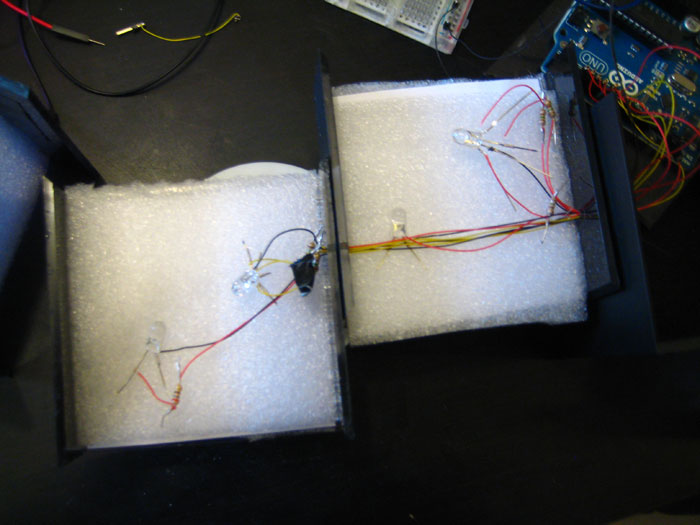
Here are some pictures of the shell of the first iteration:
For the second iteration, I pulled out the electronics of the first and just added a new outer structure. I also added sound. Here are images of that version:
It was a fun process, and I liked using sound, which I haven’t done a whole lot of before. I also like the idea of trying to convey different emotional states with just led lights. That was much harder with the 8bit sound though, at least for me. Maybe for future iterations of this kind of project I would buy a wave shield, or connect the project to a computer so that I could use Max/msp to control the sounds.
My heart box is a play on the old game operation, except with this twist: you’re operating on yourself (or a friend). First, you place the heart rate sensor on your ear. Then you pick your instrument, and try to pull your heart out of the box. If you’re successful, the heart continues to beat pink. However, if you hit the side of the box, the heart turns blue and a small pancake motor (attached to the back of the heart) buzzes. I liked working on this project a lot. It would be fun to make a large box version with more than one body part and multiple kinds of sensors.
I ended up deciding to combine my wireless toys final with my thesis, and to explore more of the production aspects of my lamps. This project is called Prisms, and its a series of small foldable lamps, that change color depending on how they are folded.
My video is here:
While the lamps worked well for a gallery installation, I still feel they’re too fragile and time consuming to be mass produced. So I decided to start looking at other ways I could create them that would be faster and more reliable. The first thing I investigated was getting pieces of Acrylic laser cut with where the circuit needed to go, so that I could either paint or embed the circuitry into the engraved areas of the acrylic.
I also worked on designing a different PCB from the one I’m currently using. Here is the current PCB:
and here is the new triangular pcb and flexible joint that I designed:
I also requested quotes for getting a batch order of PCBs (with the triangle being rigid and the joint being flexible) to be printed and populated from the following 6 places:
but I only got two responses and only one quote. Heres the quote I got:
It was interesting exploring the production side of this project, I’m still not sure if PCBs if the direction I’d like to go, but I’m glad I explored it. Also, here is a link to the presentation I made in class.
Day & Night is a tapestry that comes together with a plush butterfly. It allows kids from 2 to 4 years old interact with a moon / sun and a the wireless butterfly. When the children puts the sun in the sky, the flower and butterfly lights up because the butterfly is awake during the day. When he/she puts the moon, the starts light up and the butterfly turns off.
In future iterations I would like to create a book with different backgrounds and animals, for example an owl that is awake (lights) during the night, so when the moon is in the sky the starts and owl lights up.
In this iteration I used conductive tape and it doesn’t work very good. For the next iteration I would use conductive Velcro so it’s easier for the children to put the sun and the moon in the sky.
The first state is alarming: the lights are red and makes an alarming sound.
The second state is relaxing: the lights change from blue to light blue / pink without sound allowing the user to relax.
The third is a thinking mood, where the lights are blue and makes a “thinking” sound.
PERSONAL MESSAGES CAN EXIST OUTSIDE TEXTS AND E-MAILS.
Personal messages can and should be communicated through an exponential with meaning. The way we perceive time, structure our time and react to time is a powerful communication tool and helps set the stage for communication. I wanted to make a wireless communication situation that would exist in a monochronic time. This means that things are done one at a time and time is segmented into precise, small units.
In Feeling Presence, I wanted to promote positive thinking amongst little girls. It is a communication system for a young girl, age 4 to 8 and her mom. The users I had in mind is a child who just recently started pre-school and misses her mom and a young working mom.Feeling presence consists of a belt and purse for mom and a soft toy-like purse for the little girl. The buttons on the girl’s purse, proud, happy and kind send messages to mom’s belt. The light on the receiving end corresponds to the message sent. Blue for proud, yellow for kind and red for happy.
Previous Art:
Light On Project http://alexandertwang.com/archives/390
Did any surprises come from this round of prototyping?
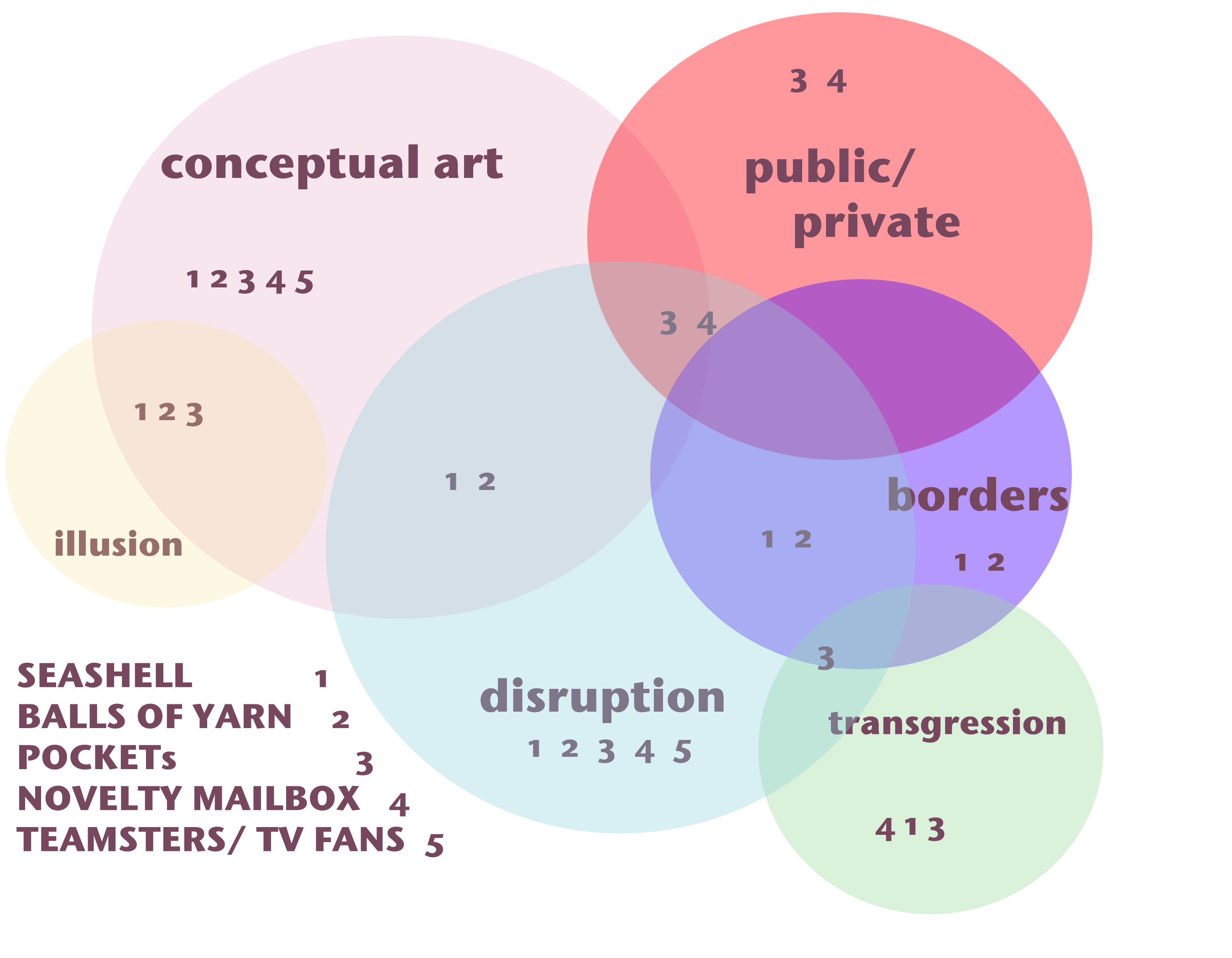
The domain exercise was a crucial component for me in the next stop of prototype making. Through mapping domains I came to conclusion that I am very interested in ideas of disruption and conceptualizing that disruption in an unpredictable way. Disruption is still communication. I now want some of my objects to disrupt its owner’s way of going about their business.
The hardest thing.
-Thinking of an usual yet provoking enclosure for the devices. Since i am moving slightly away from functionality and towards conceptual art, I am thinking of odd designs for objects that can disrupt one’s life that one can still carry with herself or utilize in some way in her/his surroundings.
The easiest thing.
-Brainstorming scenarios of the objects disrupting and communicating to its user. For example, if the device in user’s pocket receives a message, let’s say it will start screaming. The user can be on a crowded train or elevator. This disruptive object then blurs the boundaries of private and public. Becomes a public disruption.
Using a compass and maybe GPS, I will be able to map out rotation.
I have the range finder working. This will give me distance from the ground
So far as I have been able to establish, my android phone doesn’t track height from the ground. The closest application involves using gps and the built in camera to triangulate the height of a distant object.
—-Did any surprises arise from this round of prototyping?
I am astonished of the lack of precedence that I have uncovered involving this project. Rotation and height mapping are either extremely difficult to map on an individual level or not many people have had the need to do so.
—-What was the hardest thing about making these prototypes?
Again, the research. I have explored numerous techniques to achieve this goal, including collaborating with a mathematician.
Over all, I need to research compass sensors and test one.
I am still exploring smart phone applications involving this project.
—-What was the easiest thing about this round of prototypes for you?
Find the motivation to work on this is easy to come by. I’m interested in creating this project and using it. I see an immediate return in creating this and that pushes me to work at it.
My idea is to do a cloth-book for babies-kids that comes together with stuff animals.
The animals will interact with the book, for example a butterfly that will light and a bird that will sing.
The book will have on a double-page a bird nest with eggs, so when the kid presses the eggs the bird – an independent stuffed animal – will sing…. or a caterpillar on a tree that when the kid pressed caterpillar the butterfly lights up…
10 prototypes:
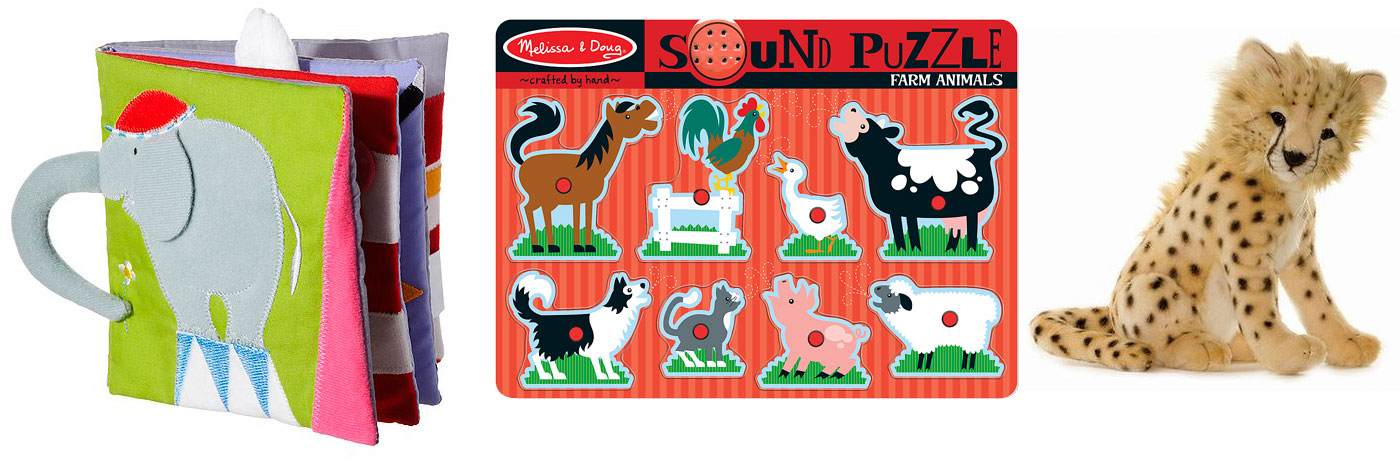
Prior Art: A cloth book, a stuff animal and a sound puzzle….
Look and Feel:
The butterfly on its two states, and the book…
Role: as a book, and also as a toy
Implementation: The butterfly lights when the caterpillar (in the book) is pressed.
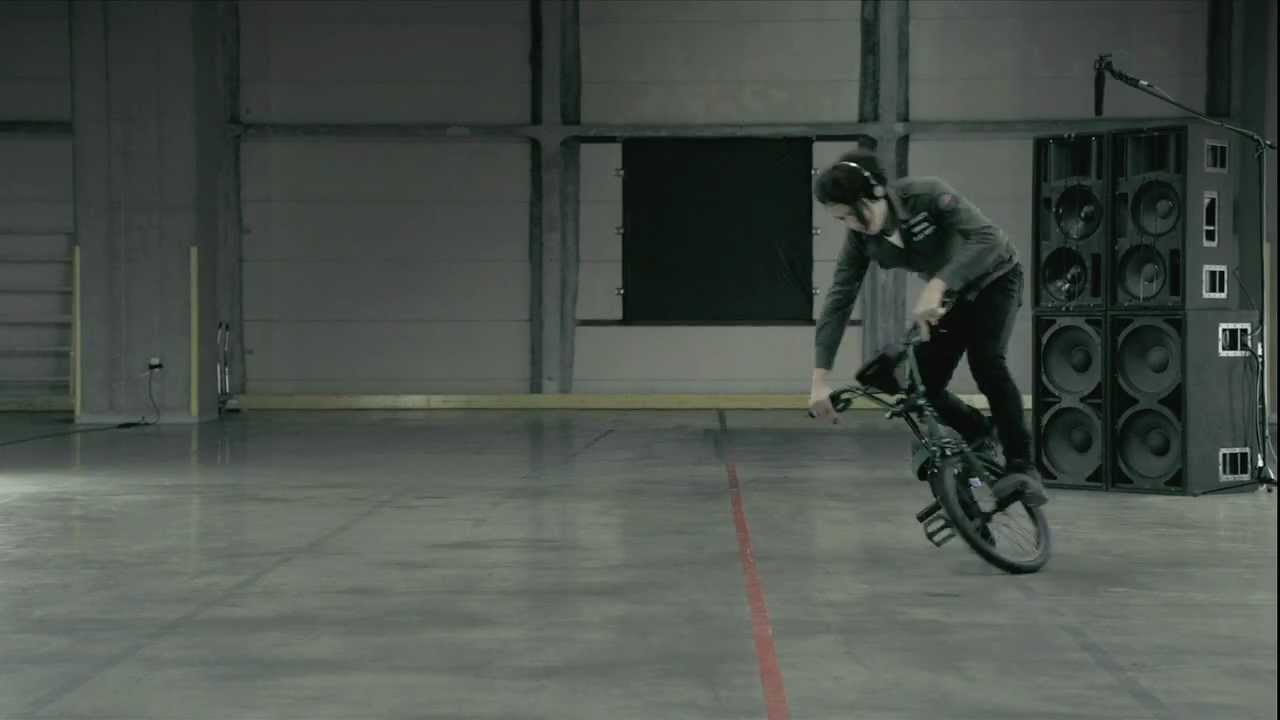
As of now my project is named “trick tracker”. It will be a device that tracks height and rotation for bmx riders. Some day I hope this device will be developed further to track an extensive library of bmx tricks.
Look and Feel Prototype:
1.
This device will be mounted on the down tupe on any bmx frame. This is the ideal placement due to it being the point of least contact during riding and other bmx tricks.
The electronics for the device will be imbedded into this foam pad that will be wrapped in decorative fabric. Not only is the padding practical but, the padding holds a nostalgic feeling to most riders and will be a retro throw back reference to the younger days of freestyle bmx of the early 1980′s.
2.
This second look and feel is strictly functional. This light weight plastic or rubber housing will contain all of the electrons and will aim to use the least amount of mounting space as possible. There is still room to play with color here but this design aims to remove itself practically and visual from the bike.
This is an example photo of a previously used bike mount for a cell phone camera, my model would ideally be similar.
Role Prototype:
1.
In the role involving the average consumer, I imagine this product being used as a way to document tricks and rider progression and sharing it on line.
2. I also can see a role being used in conjunction with a video camera app or camera app on smart phones to aid this documentation, sharing, and user experience.
3.
My last predicted role, this product could be used during televised competitions to create athletic statistics. A rider’s average speed, height, and rotation could be documented and displayed in a news ticker during the competition.
Implementation Prototype:
1. I imagine that this could be built as a smart phone app, as smart phones do possess most of the necessary hardware to achieve this. I am just concerned about physical placement of the phone on the bike or the body of the rider, and types on phones varying in too much of a degree for it to be widely accepted.
2. My second implementation involves actually building the electronics using arduino. I would like the arduino to transmit the athletic statistics to a smart via blue tooth.
I have already begun to test out a variety of sensors for this project. The height from the ground information will be gathered using an ultrasonic range finder, and rotation will use a combination of accelerometers, composes, and gyros. All of this will need to by gyroscopically mounted to the down tupe the bike frame.
3. Implementation three involves building a motion tracking suit. By using a camera in conjunction with a variety of motion tracking points on the bike and rider, one could eventually write computer vision software that tracked tricks. This is the most elaborate and complex theoretical implementation.
Precedence:
1.
Sports Bio Engineering PhD student Tristan McNab plans on developing iphone software to track athletic information during track and field sports .
2.
Chaotic Moon Labs’ “Board of Awesomeness” is intended as a technology teaser to show how perceptive computing can turn around the way we look at user experiences. The project utilizes a Microsoft Kinect device, Samsung Windows 8 tablet, a motorized longboard, and some standard and custom hardware to create a longboard that watches the user to determine what to do rather than have the operator use a wired or wireless controller. The project uses video recognition, speech recognition, localization data, accelerometer data, and other factors to determine what the user wants to do and allows the board to follow the operators commands without additional aid.
First, here is my venn diagram of domain interest. My domains are: Interaction through motion, Contemporary Art, Behavior of Litters, and Communication through Audio
Here are my examples of prior art:
HERE AND THERE: Emotional communications tool for families that are separated by long distances.
KUMA: A TEDDY BEAR PHONE: To use it, you need to pick the teddy bear up and put it’s snout near to your ear as if it is whispering to you.
FOR SOMETHING STRAIGHT UP CREEPY: ROBOT GIRLFRIEND : for lonely men. HIGHLY QUESTIONABLE. I don’t care how lonely you are.
Using her infrared sensors and battery power, the diminutive damsel named “EMA” puckers up for nearby human heads, entering what designers call its “love mode.”
She’s very lovable and though she’s not a human, she can act like a real girlfriend.”
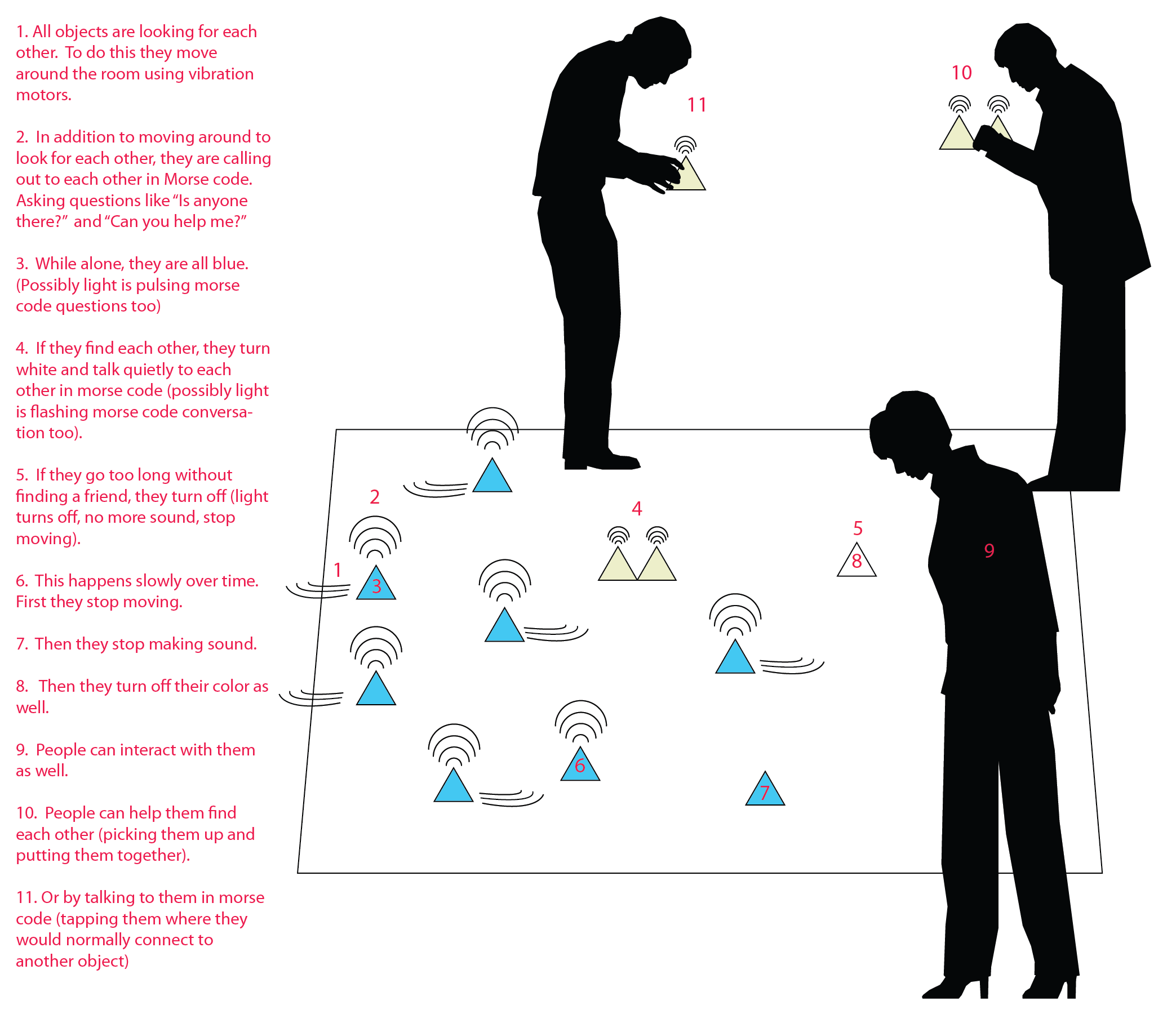
My concepts are all fairly similar, I basically know that I want to work with a group of small objects that are networked together and communicating.
Idea 1: Small animal shaped objects/lamps or small geodescic objects/lamps that communicate to each other. Each object has it’s own individual color when it is the only object in a zone. The closer they are to each other, the more they try to assume the same color. I’m not sure what would determine the hierarchy of what final color they assume, unless it is that they’re always trying to mix between the colors. (aka a red object and a blue object would always turn purple)
Loose precedent: Suwappu: http://www.dentsulondon.com/blog/2011/04/05/introducing-suwappu/
My second iteration was an experiment of creating a different shape with the fabric provided and adding additional circuits and leds, and an embedded speaker to work with the pulse sensor.
I began to see the limitations of using an arduino uno board with the pulse sensor as I would have enjoyed using pwm pins with this project to fade the lights but the timers are being devoted to the pulse sensors.
For my first use of the pulse sensor and its accompanying code, I created a heart as instructed on the pulse sensor website and embedded my arduino uno board inside it. I then powered my board with a 9volt battery. Performing this task allowed me to gain a feel of working with fabric as I have never worked with fabrics or sewing before. While doing this I also learned that the fade loop within the code actually disrupts the pulse sensors count, and the pulse was not accurate until this bit was commented out. In my next iteration I plan on creating an additional plush toy with additional circuits using more digital pins on my arduino uno board.
holy yury! thats so cool .