 Evander Batson
 xinhe feng
 FluffyLeecy
 frankiezek
 gaboratparsons
 giang063
 gracegotlost
 lauriewaxman
 Siwen Li
 Xiaofeng Lin
 Yury Gitman
 mar28th
 Max(TONG WEN)
 Soohyun
 sabotai
 Susan Lin
Here’s the video to that orchestra Adam mentioned…
Here’s the video to that orchestra Adam mentioned in class today:

Here’s the video to that orchestra Adam mentioned in class today:
I set out to create some sort of exercise tool with the pulse sensor. I’m still waiting on an accelerometer to begin piecing the project together, but I’ve begun the code and wiring diagrams to start sketching out how it will work.

These components will be fit inside a ball with the LEDs in a line following one axis. The goal of the object is for the user to orient the ball according to a set LED by tilting to make that LED face upward. The rate at which the LEDs change will be determined by the pulse sensor that it attached to the side of the ball.


My original concept was to implement this into a large weighted medicine ball, but as I sketched out a storyboard, I thought it would allow for a longer and more interesting interaction by having two hand held balls that interact with each other as the user progresses through the exercise.
I’ll talk about it in class so there’s no need to cover everything here, but for anyone that’s super bored here’s a blog entry about some of the process for this.
Here’s what I have so far for the project:
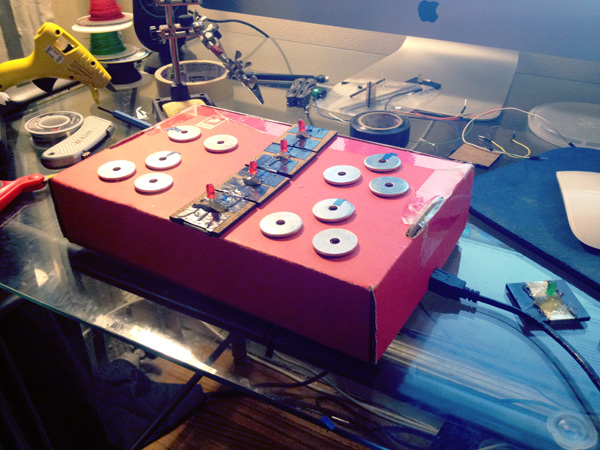
The connections on the tiles need to be made more stable so you don’t have to hold it down to ensure it’s connected. Right now the top left washers cycle through the speed of the beat, and get reset to zero. Eventually I’d like to made it so the speed fluctuates up and down, but for now it’s still an easy way to lock into a speed you want to use.
The bottom two sets of washers have some older code on them right now that’s pretty boring sounding and I’ve just been using to test things out. Eventually they will allow you to set certain parameters over the beat being made.

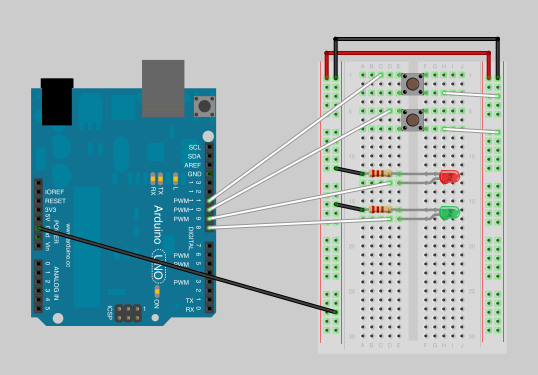
I tried to upload the Fritzing diagram with the Arduino code, but the Fritzing site is down at the moment.
I wrote up a blog entry with much great detail and pics but didn’t want to include all of that here as it would be reruns for most of the people in class.
Here’s my first iteration of the LED enclosure assignment.
And here is the second iteration, now incorporating sound.

I was out of town til Wednesday this week, so when I found out we had an assignment for Thursday’s class my main concern was just getting something presentable. I was surprised at how quickly I was able to get a working prototype with some cardboard and the wire wrap tool. Thankfully everything was laid out neatly with the header pins so I was able to test the code and ensure there weren’t any short circuits.
The code was actually the portion that took longer than I assumed it might. Making the whole series of LEDs do something was simple enough with a for loop, but trying to do any sort of pattern proved a little more counter intuitive. Using the fade code from Monday’s class I was able to add some variety to that simple sequence of LEDs turning on into something different for the “waking up” function of the box.
I studied Film and Creative Writing at the University of North Carolina at Wilmington. I freelanced for a year after graduating, including working on the pilot for the ABC show “Revenge.”
I’m in this class because I’ve been interested in developing my knowledge of physical computing and programming and looking forward to workshopping ideas with other classmates.
My favorite childhood toy was Legos

 naterudolph is discussing.
  Making Toys
Reply