 Evander Batson
 xinhe feng
 FluffyLeecy
 frankiezek
 gaboratparsons
 giang063
 gracegotlost
 lauriewaxman
 Siwen Li
 Xiaofeng Lin
 Yury Gitman
 mar28th
 Max(TONG WEN)
 Soohyun
 sabotai
 Susan Lin
mr. rosie: v01 & v02.
v01.
When we were given the pulse sensor assignment, the first thing that came to mind were ROBOTS! Humans create them, they give them life, they give them a “pulse” in a way. So I decided to create a little robot that came to life when you give him your pulse. I named him Mr. Rosie, inspired by Rosie, the robot-maid from The Jetsons.
Here are some pictures of the first iteration. He moved his hat and light up with every pulse it sensed.


v02.
For this second iteration, I wanted the moving of the servo motor to have more meaning. So I made him move his arm, with a glass of martini (or a broom?) in his hands, representing that he is ready to serve you. He’s a little butler like his wife :).
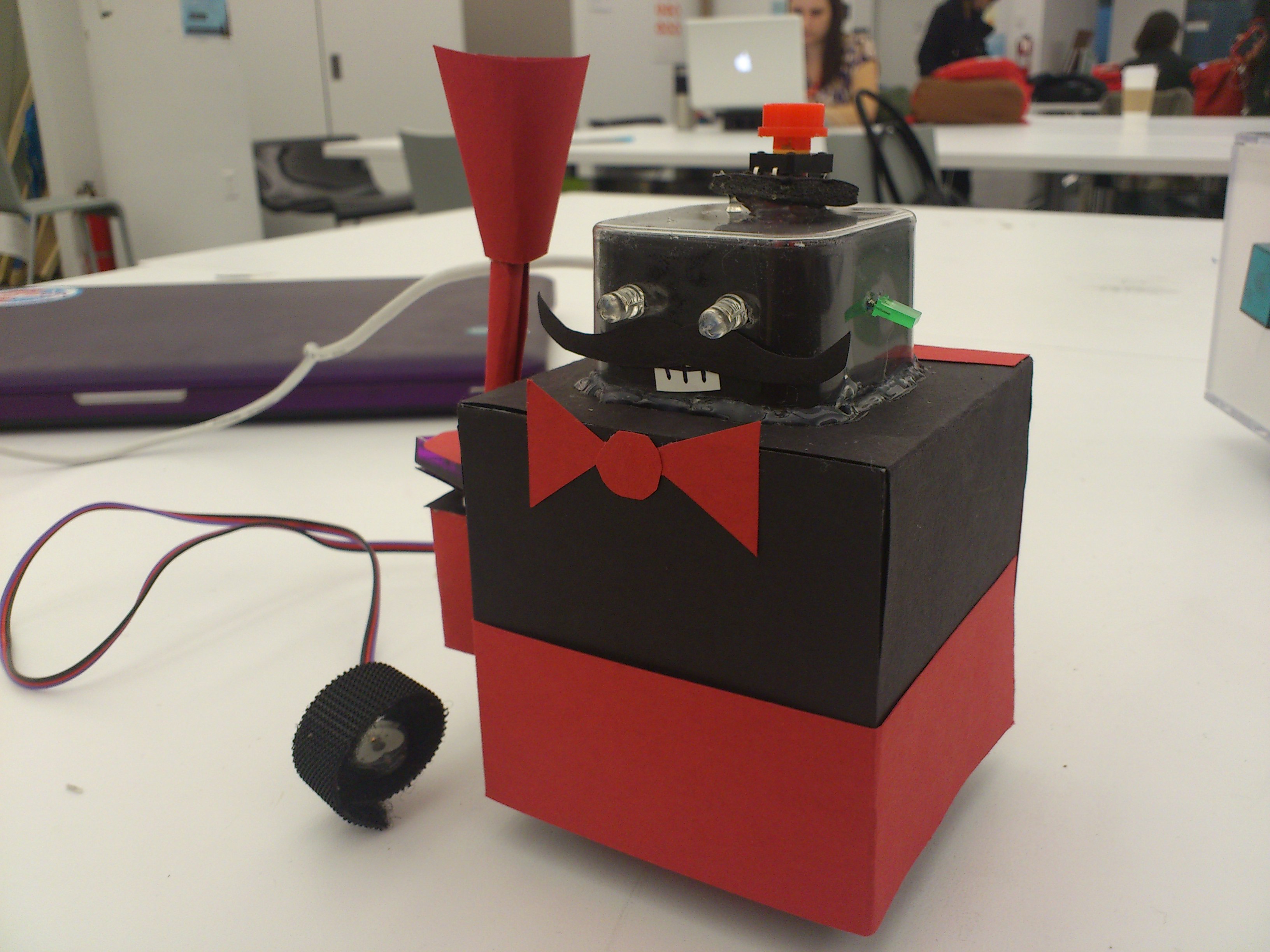


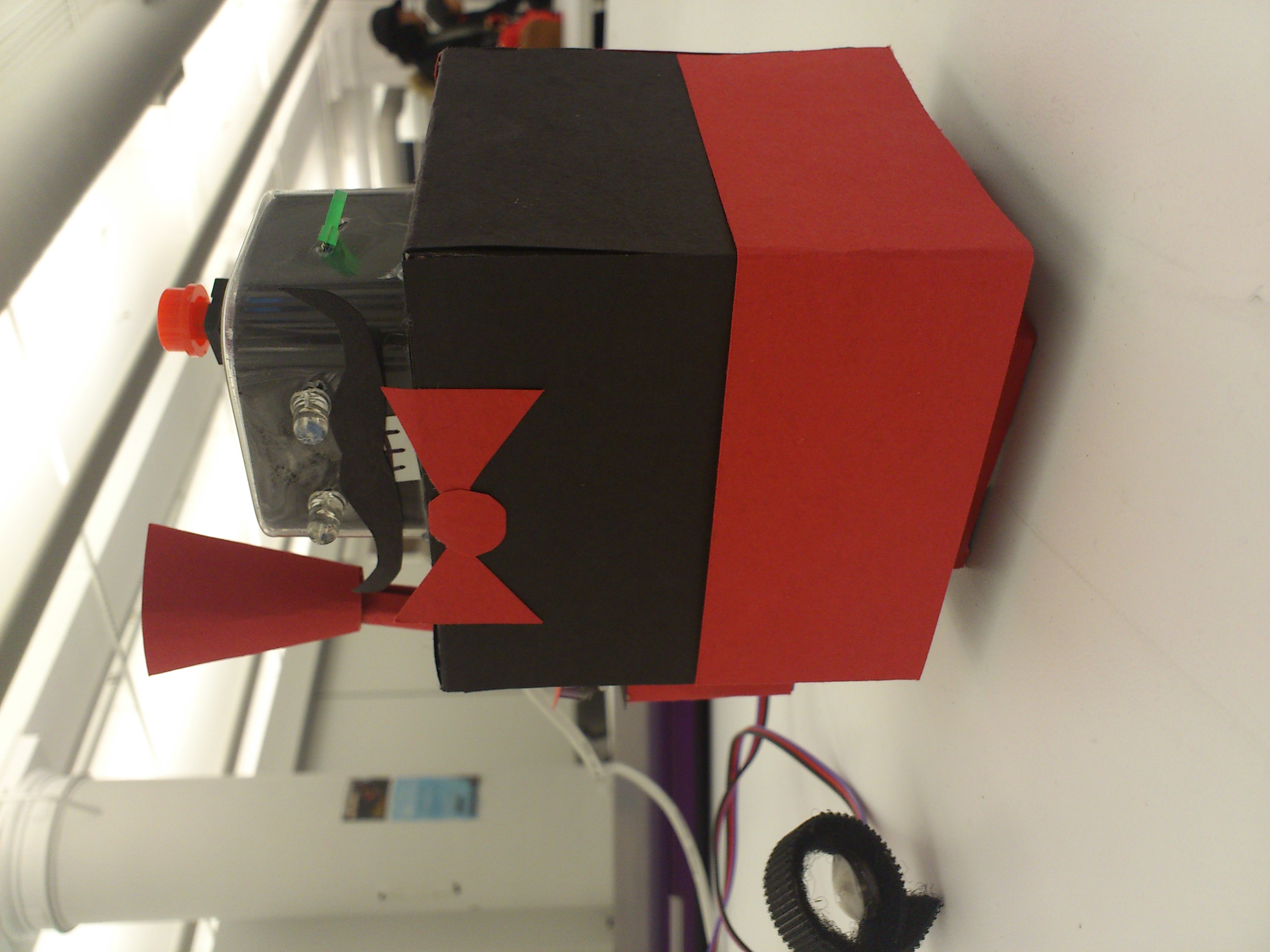

Here’s the code:
/*
This program reads data from the Pulse Sensor.
Serial output is designed to mate with Processing sketch "P_PulseSensor_xx" series
Serial Protocol initiates datastring with coded ascii character, ends each message with carriage return
We named the variable that holds the heart rate (BPM) after the group Quantified Self.
They backed our Kickstarter campaing at the $600 level and having a variable named after them is one of their rewards.
Go Count Yourself!!! http://quantifiedself.com/

by Joel Murphy & Yury Gitman in Brooklyn, Summer 2011.
*/

#include
// VARIABLES
unsigned long time; // Holds current time for pulse rate calculation
unsigned long lastTime; // Used for calculating time between beats
int Sensor; // Holds current analog Sensor Reading
int lastSensor; // Used to find waveform direction
int Peak; // Holds value of peak in waveform
int Trough; // Holds value of trough in waveform
int beats[10]; // Array to collect time between beats for calculating BPM
int beatCounter = 0; // Used to hold position in beats array
int QuantifiedSelf; // Used to hold the heart rate value (BPM)
int drop; // Holds the amplitude of waveform

int fadeRate = 10; // when arduino finds a heartbeat, it will fade an LED on pin 11 (PWM)
int Fade = 0; // Fade variable will set PWM

boolean falling = false; // used to keep track of waveform direction

// PINS
int LED = 13; // pin 13 LED blinks on each pulse
int dimLED = 11; // LED on pin 11 fades with each pulse
int PulseSensor = 5; // Pulse Sensor purple wire connected to analog pin 5

// SERVO
Servo myservo; // create servo object to control a servo
 // a maximum of eight servo objects can be created

int pos = 0; // variable to store the servo position
// -------------------------------------------------------------------------------------------------------
void setup()
{
 myservo.attach(9); // attaches the servo on pin 9 to the servo object
 pinMode(LED, OUTPUT); // set the LED pins as outputs
 pinMode(dimLED, OUTPUT);
 Serial.begin(115200); // start the hardware serial block and set the baud rate
 lastTime = millis(); // initialize lastTime variable
}
void loop()
{
 Sensor = analogRead(PulseSensor); // take a reading
 Serial.print("s"); // send raw analog data to Processing sketch (or other)
 Serial.println(Sensor); // 's' = Raw Sensor Data
// USE WITH LED ON PIN 11 FOR FADE EFFECT
 Fade -= fadeRate; // Fade variable set to 255 when heart beat is found
 Fade = constrain(Fade,0,255); // these lines fade the LED
 analogWrite(dimLED,Fade);

// KEEP TRACK OF THE DIRECTION OF THE WAVEFORM
 if (falling == false){ // if the sensor values are rising
 if (Sensor < lastSensor-1){ // if current reading is less than last reading - noise  falling = true; // a peak has been reached  Serial.print("P"); // send peak value to Processing scketch (or other)  Serial.println(Peak); // 'P' = Peak in waveform  digitalWrite(LED,LOW); // turn off pin 13 LED  }else if(Sensor > lastSensor){ // otherwise, if current reading is bigger, values are still rising
 Peak = Sensor; // record the next potential peak
 lastSensor = Sensor; // keep track of rising signal
 }
 }
 if (falling == true){ // if the sensor values are falling
 if (Sensor > lastSensor){ // if current reading is bigger than last reading
 falling = false; // a trough has been reached
 Serial.print("T"); // send trough value to Processing sketch (or other)
 Serial.println(Trough); // 'T' = Trough in waveform
 drop = Peak - Trough; // difference = signal amplitude
 Peak = 0; // setting Peak to 0 here helps get rid of noise
// THIS IF STATEMENT IS HOW THE HEARTBEAT IS FOUND IN PULSE SENSOR WAVEFORM
 if (drop > 4 && drop  timeBeat(); // go work out the BPM
 Serial.print("d"); // send the amplitude to Processing Sketch (or other)
 Serial.println(drop); // 'd' = amplitude of waveform
 digitalWrite(LED,HIGH); // start pin 13 LED blink
 servo();
 Fade = 255; // set fading LED to high brightness

 }
 }else if (Sensor < lastSensor){ // otherwise, if current reading is smaller weʻre still falling
 Trough = Sensor; // record the next potential trough
 lastSensor = Sensor; // keep track of falling signal
 }
 }
 delay(20); // break for 20mS. Processing frame-rate = 100.

}// END VOID LOOP

// SERVO FUNCTION

void servo(){
for(pos = 0; pos < 30; pos += 1) // goes from 0 degrees to 180 degrees  { // in steps of 1 degree  myservo.write(pos); // tell servo to go to position in variable 'pos'  delay(10); // waits 15ms for the servo to reach the position  }  for(pos = 30; pos>=1; pos-=1) // goes from 180 degrees to 0 degrees
 {
 myservo.write(pos); // tell servo to go to position in variable 'pos'
 delay(10); // waits 15ms for the servo to reach the position
 }
}

void timeBeat(){
 time = millis(); // take note of the current time
 beats[beatCounter] = time - lastTime; // record miliseconds since the last pulse in beats array
 lastTime = time; // stay up to date!
 beatCounter ++; // move array pointer to next position in array
 if (beatCounter == 10){ // if we've taken 10 readings, it's time to derive heart rate
 QuantifiedSelf = getBPM(); // go derive the heart rate
 Serial.print("q"); // send the heart rate to Processing sketch (or other)
 Serial.println(QuantifiedSelf); // 'q' = heart rate
 beatCounter = 0;
 }
}// END OF timeBeat FUNCTION
// This function will return a value for heart rate (Beats Per Minute)
int getBPM(){
 int dummy; // used in sorting
 int mean; // used in averaging
 boolean done = false; // clear sorting flag
// this simple sorting routine will arrange values in the beat array from lowest to highest
 while(done != true){
 done = true;
 for (int j=0; j beats[j + 1]){ // sorting numbers here
 dummy = beats[j + 1];
 beats [j+1] = beats[j] ;
 beats[j] = dummy;
 done = false;
 }
 }
 }
// this FOR loop selects the longer beat time values to avoid incorrect heart rate readings
 for(int k=1; k mean += beats[k]; // add beat times together
 }
 mean /=8; // averaging
 mean = 60000/mean; // devide 60 seconds by average pulse length
 return mean; // return beats per minute
}// END OF getBPM function
 Making Toys
Reply