Updates from February, 2009 Toggle Comment Threads | Keyboard Shortcuts

  • Unknown's avatar

    Yury Gitman 2:16 pm on February 20, 2009 Permalink | Reply  

    Library Research 

    My library research yielded several results of time based media.

    The first example I found was featured in the book "Type in Motion 2" by Matt Woolman.

    The featured project is entitled "Industorious Clock" and is by Yugo Nakamura. This site can be still viewed online at http://www.yugop.com/ver3/stuff/03/fla.html, despite being created in 2001. I think the fact that this site is still relevant and impressive in a time where projects quickly becoming outdated looking speaks to the quality of the project. As you can see by viewing the site, the time is drawn by hand in video format, and then quickly erased. As the time moves towards greater increments (seconds to minute to hours etc) the motion becomes almost beat-like, creating a hand drawn animation of time.

    "Circular Breathing" is an installation work by Gary Hill created in 1994. The book "Seeing Time", a group of excerpts from the Pamela and Richard Kramlich Collection, describes the works functionality as such:
    "In Circular Breathing, sound is a constant presence that unites a series of fleeting images inside a visual and aural circuit. Five large black-and-white images appear sequentially, from left to right, across a wall of the gallery. As each successive image appears, its speed, and the speed of the sound, is "shared" with the previous ones, until all five images reach an almost photographic stillness, ground to a halt and blurred by the heavily slowed-down sound. As the last image slides off to the right, the sounds resumes its original speed, until it is replaced by another, full-speed sound and a sharp image, both emerging from the left. "

    The video speed and motion reflects the breathing patterns of a human being, and the immersive video slowly begins to engulf the viewer as their own circadian rythms begin to sync with their environment. I think this use of the bodies built in timing as a means of expressing the passage of time is a great and really creative.

    Here's a video of it I found online:
    http://www.sfmoma.org/multimedia/videos/219
     
  • Unknown's avatar

    Yury Gitman 2:15 pm on February 20, 2009 Permalink | Reply  
    Student Presentation #2 – Cecelia & Kirsten 

    (Press pause to see each slide individually)

    Download StudentPresentation2_Cecelia_Kirsten

     
  • Unknown's avatar

    Yury Gitman 12:51 pm on February 20, 2009 Permalink | Reply  

    Passage of Time / Ira Goldberg 

    After a very long night of work and burned fingers I finally finished  this new iteration.
    I've tried to create a group of sheep (3) and make them blink on count. It turned out much more complicated then I thought it might be. The problem was the arduino board, I really wanted to hide it. Originally I just wanted to have separate 3 sheep. But the arduino board is still there, maybe if there is a way to make it wireless…
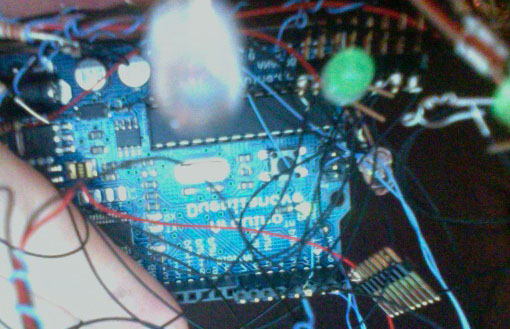
    Eventually at 6:00am when it seemed to be finished, that is how my arduino board looked like:

    MessArduinoBoard

    I had so many wires and resistors, and they all got so messy, It was almost impossible to deal with.

    So I decided to start over. I minimized the number of pins that I use on the arduino board by using a lot of serials connections. This is the final board:

    NewArduinoBoard

    And this is how my Counting Sheep Prototype looks for now:

    Sheep1

    Sheep2

     
  • Unknown's avatar

    Yury Gitman 12:34 pm on February 20, 2009 Permalink | Reply  

    Telegraph – 2/13/09 class paper 

    What were the specific technical issues referring to wire and resistance, that presented the early telegraph to be wired directly, coast to coast. What solution finally worked? Illustrate how that works, allowing coast to coast telegraph communication.

    The longer the wires, the more resistance they have. More resistance – less current flows. The usage of thicker wires or higher voltage lowers the resistance but it still was limited to a couple hundred of miles.
    The solution was a relay station; that uses electromagnet as a switch, which, activates by current and resends the message further (by an amplified current).

    Telegraph

     
  • Unknown's avatar

    Yury Gitman 11:15 am on February 20, 2009 Permalink | Reply  

    Code class paper 

    What were the specific technical issues (refering to wire + resistance) that prevented the early telegraph to be wired directly coast to coast?

    What solution finally worked?
    Illustrate how that works, allowing coast to coast telegraph communication.

    The thicker and long the wire, the less resistance it has. This is why wires can't be extended indefinitely.
    When the telegraph was created, the solution found for a long distance communication was having human relays, that stayed all day in a box in the middle of nowhere receiving and sending back messages to be delivered. At a certain point, they discovered that a human being wasn't necessary for the message to go through, because a single piece of wood attached to both the sounder and the keys was a good mecanism to type the message. 

    The key is composed by wires and electromagnet for the current to go through. People finally discovered that the electromagnet emitting current could be used to trigger a switch everytime it was on.

    Telegraph
     
  • Unknown's avatar

    Yury Gitman 11:02 am on February 20, 2009 Permalink | Reply  

    Time pieces 

    1. Online projects

    John Cage: 4'33'' for piano (1952)

    Musique piece that lasts for 4 minutes and 33 seconds. The piece is silent. Time sets the rhythm, and is t the major component of the music.

    A beautifully orchestrated chain reaction with common objects. Each elements gives life to the next one.
    2. Projects from books

    Marepe: "Veja Meu Bern" (2007)

    Sc00065e92

    Displacement is an important element of this piece. Created to last only two days at Tate Modern's turbine hall, it illustrates the ambiance of a brazilian funfair.

    Cai Guo-Qiang: "Head on" (2006)

    Sc00077ac6

    "My installations have consistently pursued a temporal fluidity, in contrast to the stylistic freedom I allow myself. However, my works in essence contain these characteristics: a participatory nature and a flow of time".
    Cai Guo-Qiang
    3. Toy Fair

    Fascinations

    Sc00081093

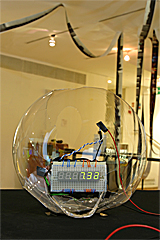
    Although I really don't like its black box design, I enjoyed the system on this clock displaying time and messages in the air. Using persistence of vision, the clock appeared magical.

    Shailie

    Sc000875fe

    Sc00088fec

    This design doesn't include technology, but it is a smart way for girls to develop their creativity, power of decision and their taste.
    The cute little dress form comes with a plain white dress, and then girls pick up fabrics and accessories to create their princess dress.

     
  • Unknown's avatar

    Yury Gitman 10:08 am on February 20, 2009 Permalink | Reply  

    Time pieces 

    1. Online projects

    John Cage: 4'33'' for piano (1952)

    Musique piece that lasts for 4 minutes and 33 seconds. The piece is silent. Time sets the rhythm, and is t the major component of the music.

    A beautifully orchestrated chain reaction with common objects. Each elements gives life to the next one.
    2. Projects from books

    Marepe: "Veja Meu Bern" (2007)

    Sc00065e92

    Displacement is an important element of this piece. Created to last only two days at Tate Modern's turbine hall, it illustrates the ambiance of a brazilian funfair.

    Cai Guo-Qiang: "Head on" (2006)

    Sc00077ac6

    "My installations have consistently pursued a temporal fluidity, in contrast to the stylistic freedom I allow myself. However, my works in essence contain these characteristics: a participatory nature and a flow of time".
    Cai Guo-Qiang
    3. Toy Fair

    Fascinations

    Sc00081093

    Although I really don't like its black box design, I enjoyed the system on this clock displaying time and messages in the air. Using persistence of vision, the clock appeared magical.

    Shailie

    Sc000875fe

    Sc00088fec

    This design doesn't include technology, but it is a smart way for girls to develop their creativity, power of decision and their taste.
    The cute little dress form comes with a plain white dress, and then girls pick up fabrics and accessories to create their princess dress.
     
  • Unknown's avatar

    Yury Gitman 12:35 am on February 20, 2009 Permalink | Reply  

    another eye/ear-candy piece }o.0{ 

    1000s of LEDS, smooth sounds and great visuals! enjoy.

     
  • Unknown's avatar

    Yury Gitman 11:15 pm on February 19, 2009 Permalink | Reply  

    Time pieces 

    Online

    Volume at Victoria and Albert Museum

    Volume is a light and sound installation created by Unite Visual Artists and one point six. It responds to human movement.

    Bodysnatchers – Zeno Music Visualiser

    This is an awesome generative and audio reactive piece created by Glenn Marshall. He has done lots of great work.

    http://vimeo.com/moogaloop.swf?clip_id=1994927&server=vimeo.com&show_title=0&show_byline=0&show_portrait=0&color=00adef&fullscreen=1

    Library

    OsmoseCharlotte Davies

    Bild


    Osmose is a wearable interface
    that immerses the user, referred to as the “driver”, in a virtual world and
    plays through a narrative that the user can interact with and experience
    “osmotic” transitions. Various gestures made by the user
    are interpreted within the virtual simulation.

    – Grau, O., 2004. Virtual Art: From Illusion to Immersion. The MIT Press.

    The
    Flock - Mark Grossman

    Theflock

    Three large robot arms are entwined and hanging from the
    ceiling. Not only do these arms respond to any visitors’ positions, they
    communicate with each other in unintelligible machine language.

    – Morse, M. 1998. Virtualities : Television, Media Art, and Cyberculture. Indiana University Press.
     
    • Thai's avatar

      Thai 12:25 am on February 20, 2009 Permalink | Reply

      Whoah…those are some pretty smooth pieces…I see some influence in your work! Are you bringing your piece to class? Think we would all like to see it…

  • Unknown's avatar

    Yury Gitman 10:55 pm on February 19, 2009 Permalink | Reply  

    Toy Fair2009 

    First of all the toy fair was amazing, I was so excited to be there. So many toys at the same place! Awesome!
     My favorite toy wasn't an interactive or even an electronic toy. Andi's Green, "WorryWoo Monsters" are stuffed, soft and very emotional monsters. There is something so real, unique  and so sensitive about these monsters that I immediately felt in love.

    Picture 5

    Another toy that I find interesting, is the Smart-E-Bear from Intellitoys Team, is an interactive stuffed toy that interacts by music, stories and games. It can be connected to software and be customized.

    Picture 6

    Online Timepieces:

    The "Art-O-Meter" by Marcelo Coelho. The piece found on "www.we-make-money-not-art.com".

    Picture 7

    This is a device that has a sensor that measures the time that the viewer spends in front of an artwork.
    http://www.we-make-money-not-art.com/archives/2006/10/art-o-meter-is.php

    The "Birth Clock" by Alexandra von Feldmann. The piece found on "www.we-make-money-not-art.com"

    Picture 8  
    Picture 9

    This piece is a nonfunctional clock in a very fragile glass container. To make the clock functional the user have to break the glass container. I like that work a lot, the user have make a decision if he prefer the shape or the function of the clock.   
    http://www.alex-vf.com/portfolio/rca/time.html


    Library Timepieces:

    Francis Alys
    Time Lapse, 2001
     
    Picture 1
    The image is from: http://www.fundacion.telefonica.com/at/colfotografia/paginas/e03.html

    During  twelve hours, Francis Alys recorded people hiding from the
    heat under the shadow of the flagpole in the "Zocalo" the famous
    municipal square in downtown Mexico City.

    After that he combined the photographs with astronomical data drawings that shows the path and angle of the sun.

    "Strangers: The First ICP Triennial of Photography and Video", 2003

    Vito Acconci
    Watch, 1971
     9 min, b&w, silent, Super 8 film on video
     
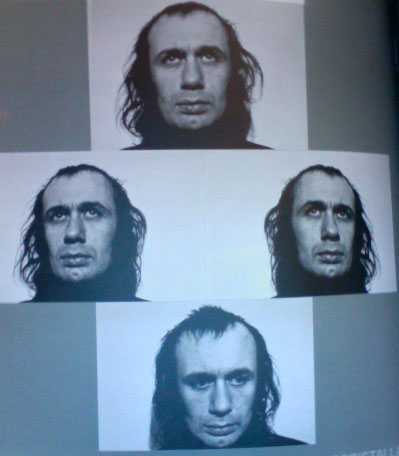
    Video/Body art; this is a close up of Vito's face following the circulation of a watch, by doing that his face represents a watch.
     

    VitoAcconci

    Vito Acconci, Diary of a body. 1969-1973.

     
  • Unknown's avatar

    Yury Gitman 9:36 pm on February 19, 2009 Permalink | Reply  

    ::Spykee WIFI::

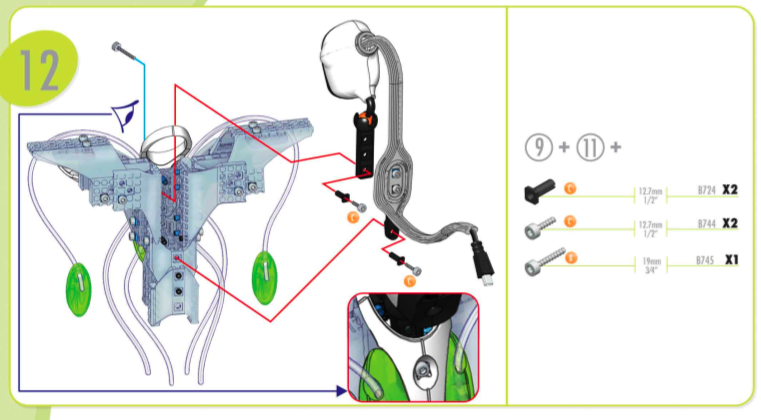
    This little robot called Spykee The WIFI Robot is made out of 200 parts that you assemble together. Three different version can be built with the same kit: Robot, Lunar, and Scorpion. Spykee can move, hear, speak and take pictures, record video and be controlled by computer anywhere in the world  via WIFI on the internet. This means  that all this input data that is perceived by Spykee  is accecible to you.  You can can then control in response a digital video camera, microphone, loudspeaker and two motors. Spykee is marketed as a spy robot because it has video surveillance device with a motion detector that can react by activating an alarm or send you a picture via e-mail. Basically Spykee is not only a mobile interface to the internet but also has a neat little feature that  I wish my cell phone could have. Spyke returns automatically to its charging base when the battery needs recharging. Spykee WIFI is also a telephone. It can make free phone calls through the internet by using VoIP phone.

    Ray Renteria, argues in Missing the Point with a Potentially Game-Changing Robot “Toy”,  that even tough Spykee WIFI down fall is that is not programmable, it does allow for  telepresence which is often overlook as a strength of this robot.

    And there is already a crack so you can control Spykee WIFI with your IPhone.

    Spykee WIFI

    Picture 8Picture 6

    ::Swinxs::

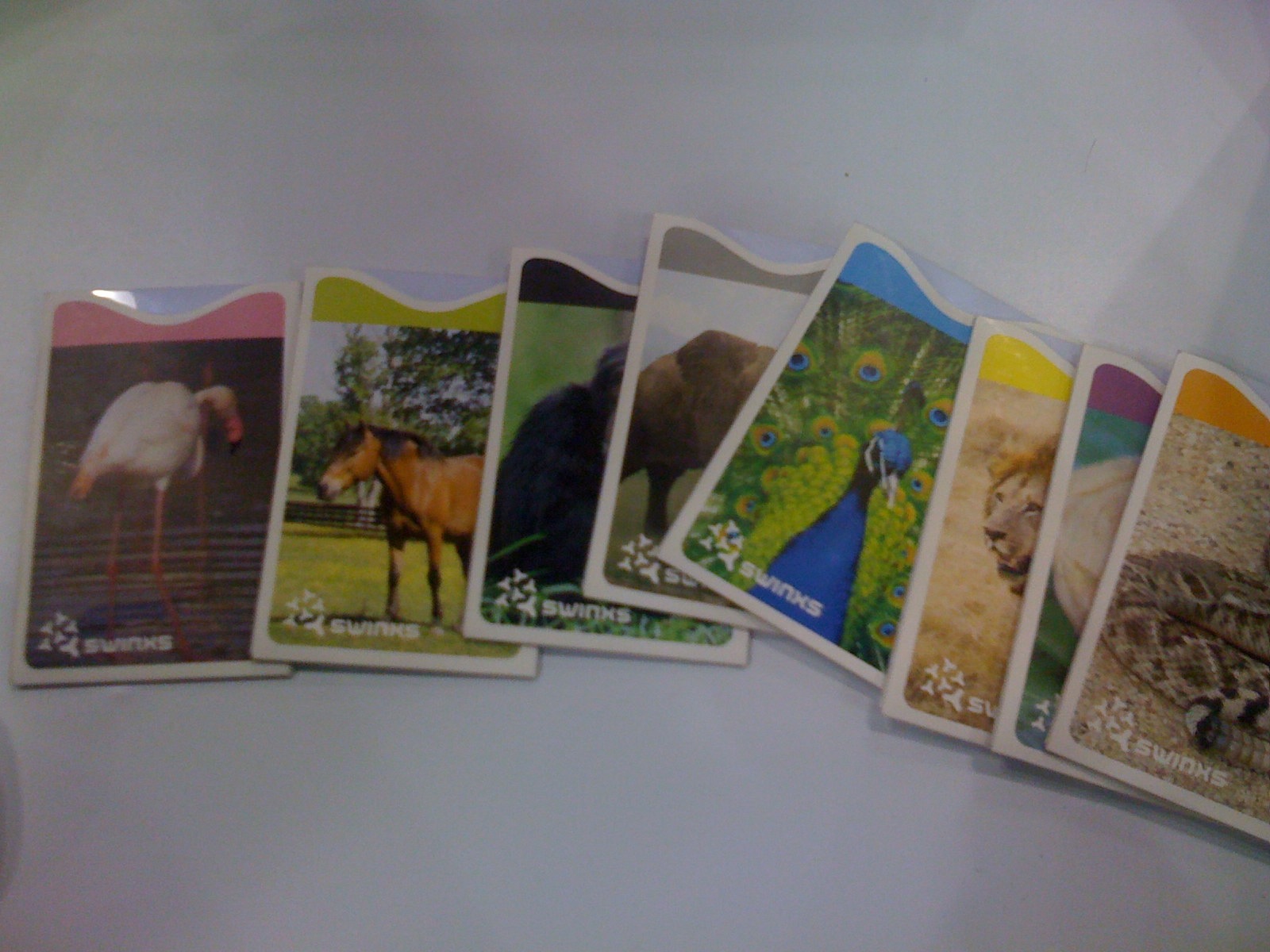
    Collecting information at the Toy Fair, such as details of the different technologies embedded in the toys, prove to be  a bit tricky. It was not so much  because of secrecy but because in most cases the people at the booth were either manufacturers of sale representatives which some time did not have access to these details. One booth that was the exception was the booth for Danish toy, Swinxs. I had the opportunity to interview one of the developer of Swinxs, Govert de Vries, and here is  what I gathered:

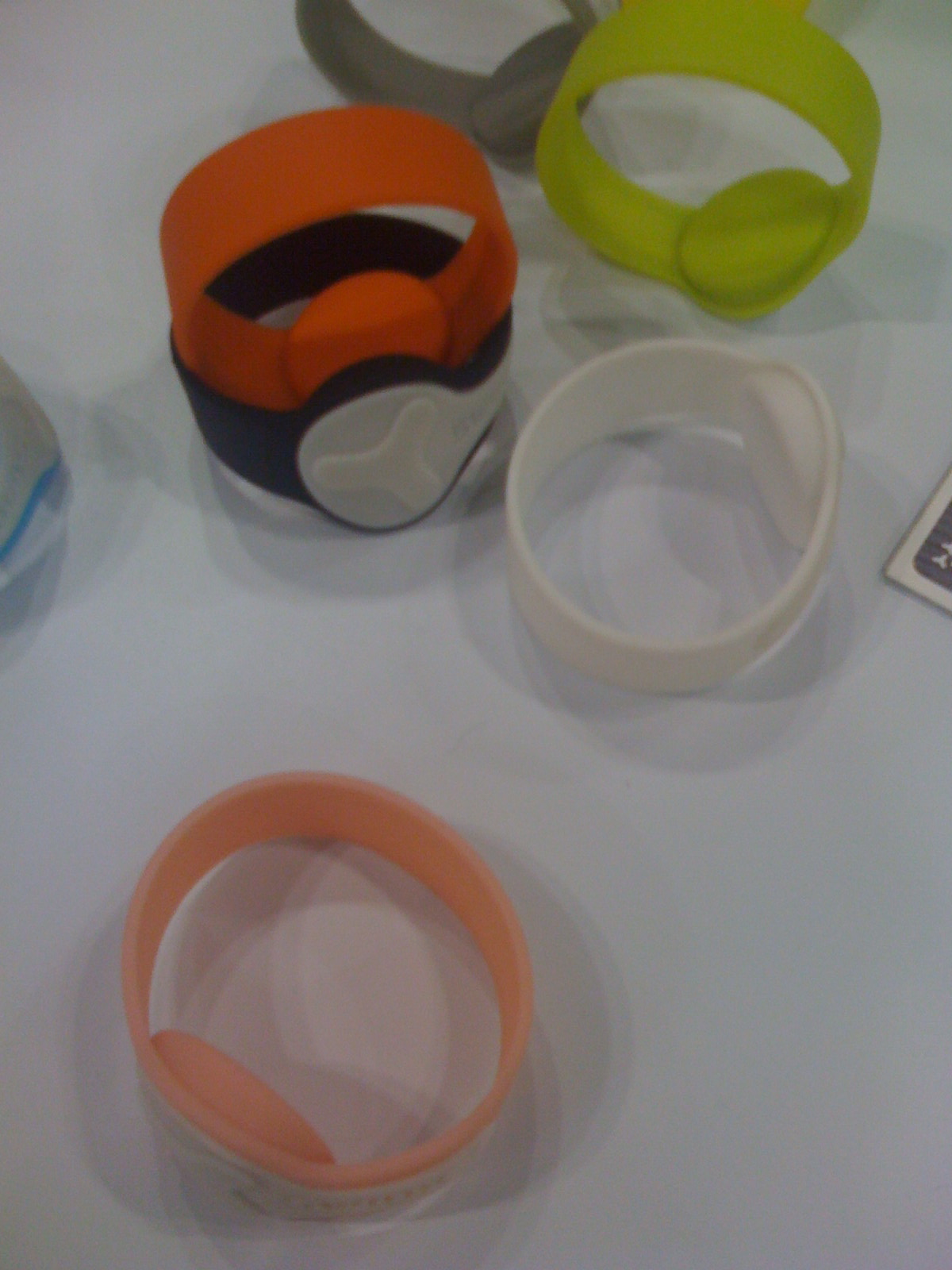
    Mr. Vries and a friend were brainstorming about creating game that would provide a frame work for children to play outdoors. The idea continued to get refined and was brought to Khadi Feiz who designed the interface  of Swinxs. The interface consist of a base with an accelerometer, a microphone, LED lights, a speaker, a RFID reader, and a USB connection that allows the user to upload new games to the console. The XS-TAG , are colorfull armbands that connect to the console by  RFID tags embeded in them. The next step in the development of Swinxs, to make the game open platform so users could not only upload new games to the console but also be able to create them, came from an unexpected source. The original programing language used to program Swinxs was Assembly. While Assembly proved to be difficult for the general public to use, a programer that had purchased Swinxs offered to create a simpler way to program new games for the Swinxs. Currently the Swinxs website provides tutorials and a forum for programing new games. Govert de Vries sees  Swinxs as a fluid game console that can continue to evolve thanks to the community of users and developers. Because of an earlier converasation with Toy Fair an attendie, he was interested in the possiblities of play that Swinxs can provide to children with dissabilities.

    ::Console::                                                 

    IMG_0578 

    ::XS-TAG::

    IMG_0580

    ::RFID tags Playing cards::

    IMG_0579


  • Unknown's avatar

    Yury Gitman 9:31 pm on February 19, 2009 Permalink | Reply  

    Passage of time iteration 3 

    Here’s my third iteration of the passage of time. This is a much higher fidelity construction than the last version and a lot of time was spent on the outer body construction. The inside of the container is sandpapered and an additional sand papered plastic layer is added on the inside to diffuse the light. Strips of black paper are stuck on to the outside of the container to block out light in specific areas and create a slat like effect. The top and bottom of the container are painted black to avoid leaking any light. The code is also modified for a different pattern.

    Photo 63
    Photo 65
    Photo 66

    http://vimeo.com/moogaloop.swf?clip_id=3290982&server=vimeo.com&show_title=0&show_byline=0&show_portrait=0&color=00adef&fullscreen=1

     
  • Unknown's avatar

    Yury Gitman 8:51 pm on February 19, 2009 Permalink | Reply  

    [Time Piece] & [Toy Fair09] 

    I am glad we had the chance to visit toy fair this year.  Thanks Yuri for getting us tickets!
    My favorite 2 toys oddly enough, were not electronic.  They were:

    4D puzzle of New York – Build NYC as a puzzle in 3D as time [4D] progresses
    ~ this means from grass to infrastructure, from building to building.
    You are instructed to remove the Twin Towers and then go in to the future
    where you place in the Freedom Tower.  Its cool to be able to see the
    skyline of NYC at difference eras in time. Comes complete with history guide booklet.

    4d

    Rbit Wheel – Nick posted this up as one of his favorites below.  I really loved the thing.
    It really seems so simple to just get on the thing and start skating.  They didn't let
    me sample the equipment but it really looks like something you can do without knowing
    how to actually skate [roller blades, skates etc.] – which is a huge benefit to kids
    that are having a hard time learning how to skate and feel discouraged.  Really
    it just looks like a lot more fun than regular skating -  minus the high speed aspect
    of roller balding, but I don't think they market would really care too much about that.
    [picture posted on Nicks entry]

    [time piece] – Okay a huge reason why I am here and a great inspiration for my work is JAMES CLAR he IS the Man.  His works are really clean, simple and CREATIVE.  Below is just one of his
    amazing pieces.  Its not high-techy, but that's the beauty of it.  You look at the thing and say
    oh….I could make that – but maybe I wouldn't have thought about seeing it in that way~

    Jamesclar_line_1

    by the by -  When you have kids one day and they ask for a car…tell 'em you get the a new TOYOTA, then you can give them this instead!

    Review_vcdyoda_1

    Cheers!

     
  • Unknown's avatar

    Yury Gitman 4:23 pm on February 19, 2009 Permalink | Reply  

    The TIA Toy Fair and Some Research on Time 

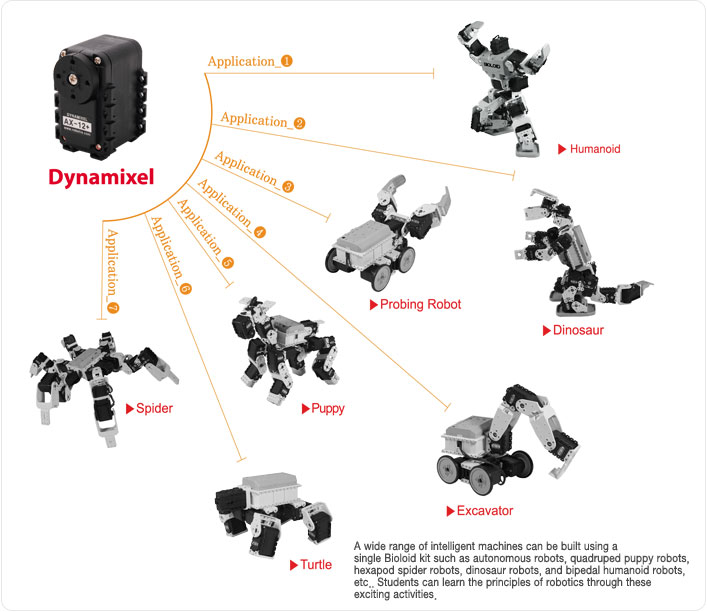
    I came across quite a number of interesting toys at the toy fair, but my absolute favorites included the exhibit by Korean robotics company, Robotis and their line of Ollo robot systems. There was a malleable pen containing two robotic animals that we were able to manipulate into action using remote controls. I was informed that the robots were designed such that they could be simply constructed by children, and that older children, beginning at around a 9th grade level, would be deemed capable of programming the robot to perform tasks of their own whim. Here are a few of the toys I saw, programmed to perform various different actions… I took a great fancy to the turtle:
    Turtle

    The other favorite from the show was Pint Sized Productions' Food Chain Friends plush toy sets. They are just kind of delightful and appealing, and I think kids should know about the food chain and all that, of course, but mostly I just thought they were really cute and fun and well designed.
    Food-chain-friends

    Going onto the other portion of this posting, I did a bit of research on the different symbols that have been used as gestures indicating the passage of time. One of the most poignant examples that came to mind is the analysis of tree-rings to determine the lifetime of a tree. It is fascinating that much can be understood by looking at the width of these things, telling a simplified story of environmental patterns throughout the tree's life. It is so simple and unilateral that the variation is all the more meaningful from ring to ring.

    Treerings

    Another, totally different gesture representing the passage of time is the circular rose-window in the medieval Lincoln Cathedral, which faces north. From a vantage point inside the church, one is able to see the rotation of the constellations of the north stars through the circular holes in the stone, as well as recognize the passage of seasons.

    LincolnCathedral 

    Doing some research in the library, I was leafing through a book called Clocks & Watches, by Johann Willsberger. In this volume I came across a really frivolous but interesting specimen of timepiece from the latter 16th century (now preserved in the Würtemburgisches Landesmuseum in Stuttgart in the Fremersdorf Collection), composed of a round platform upon which are a gilt copper ostrich being led by leash attached to the neck of a small bear cub holding a drum. When the quarter hour strikes, the bear opens its mouth & moves its head. On the hour, the bird moves its beak, rolls its eyes, and flaps it wings. When the alarm is triggered, the bear beats the drum. I found this to be a fascinating and droll way of spending one's time creating a gesture to suggest the passage of time.

    Another quite unusual timepiece was a type of gravity-driven clock desribed in Clocks and Watches 1400-1900 (© 1967 Eric Bruton), the rolling clock, or the inclined plane clock, a drum-shaped device placed on a wedge-like stnd. The drum slowly rolls down the stand over the course of what was usually set as a week. I discovered this photo of such a clock online:

    Rollingclock

     
  • Unknown's avatar

    Yury Gitman 3:31 pm on February 19, 2009 Permalink | Reply  

    Time Based Art Works — Internets 

    THE BIGGEST DRAWING IN THE WORLD.
    Erik Nordenankar created a briefcase that contains a GPS tracker and traveled around with DHL with specific coordinates. The output contour drawing is from his locations that he visited.  Watch the you tube video below for a project overview, or check out the site biggestdrawingintheworld.com.

    DIGG Visualizer

    This visualizer maps all of the latest DIGG's for certain subjects. Every time that one is added to DIGG, it is updated in real time. As the time goes on, the stacks get taller and taller. There are 5 options for visual representation, but I prefer the stack version.

    http://labs.digg.com/stack/

    Digg

     
  • Unknown's avatar

    Yury Gitman 12:37 pm on February 19, 2009 Permalink | Reply  

    Timepieces and the Toy Fair 

    Online Timepieces

    One of my favorite timepieces is a
    painting by Giacomo Balla. Balla, who was part of the Futurists Group,
    became preoccupied with depicting
    light, movement and speed in 1909. I love how the dog, human, and leash
    are visible (unlike some of the Cubists work) and yet full of motion and life.

    (click on the image to read more about Balla)

    Balla's
    (Below)
    Krzysztof Wodiczko has created more than
    seventy large-scale
    slide and video projections of politically-charged
    images on architectural façades and monuments worldwide since 1980.
    I love watching the videos of his projections – they bring the
    architecture to life and tell the stories of people affected by
    traumatic events. This piece is, "Hiroshima Projection."

    (click on the image to watch the video)
    Krzysztof Wodiczko's Projection on the A-Bomb Dome in Hiroshima, Japan
    ________________________________________________

    Library Timepieces

    Calendarium, 1476

    From 1476 until 1486, Erhard Ratdolt worked closely with Bernhard Maler and Peter Loeslein to create the first totally printd book. In 1476, "Calendarium" was completed. As sceientists began to understand natural phenomena, fear and superstition were no longer such a huge part of people's lives – eclipses began to be recognized as predictable fact as opposed to black magic. This page (above), calculates the solar cycles – the two top circles were printed on heavy paper, cut out, and mounted over a larger woodcut with tape and a string. If I were presented with this piece I can't say I would understand how to use it but scientifically, I think it's briliant and graphically, I think it's beautiful.

    (Information taken from Meggs' History of Graphic Design – by Philip Meggs and Alston Purvis)


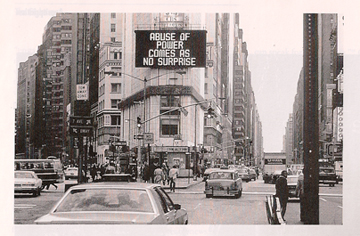
    Jenny Holzer,
    Jenny Holzer was a participant in the "Time Square Show" in June, 1980. She started her "truisms" in 1977 – initially printing them but later displayed them electrinically.

    "Holzer's manipulation of "almost" familiar phrases displaces the clear presence of a personal voice – the words seem impersonal, underscoring the essential emptiness of the media and the strange isolation of people from one another in this society of mass-culture cliches."

    I love this piece because it uses somewhat modern technology (very modern for that time) to express an idea to the masses. I also love this piece for it's placement – I was just in Times Square last weekend and it's so interesting to see how technology has greatly altered that space.

    (information and quote taken from, Art Since 1940, Strategies of Being – by Jonathan Fineberg)

    ________________________________________________

    Toy Fair

    Ollo_Swinxs

    The Ollo toys (upper left) intrigued me because they could be built to move (using motors or the programming technology) or similarly to legos, they could be built as static structures. The overall aethetic of the toy was also interesting to me. They had a rough, robotic look but they still seemed cute.

    The Swinxs game (upper right) is "an incredible new game console that can talk, explain games, recognize players and even referee." The woman at the booth spent some time explaining the toy to me and allowed me to watch the video presentation and ask a lot of questions. This is such an interesting, fun console that I wish I had grown up with!

    WildPlanet_Plush 

    The Wild Planet game (upper left) is such a cute game for small children. When I first got to the booth, the woman behind the desk wouldn't let me inside to see the toys (for confidentiality reasons) but because my friend works for Wild Plant, I asked for her and was allowed in. This game uses RFID chips to allow the child to place the mouse ears over the character and recognize when an answer is correct.

    I took a picture of the stuffed animals (upper right) because I like the muted colors and materials used. These animals were created using recycled materials and all natural dyes. I think I would like to create this look for my final project.

     
  • Unknown's avatar

    Yury Gitman 2:50 am on February 19, 2009 Permalink | Reply  

    time-based online findings 

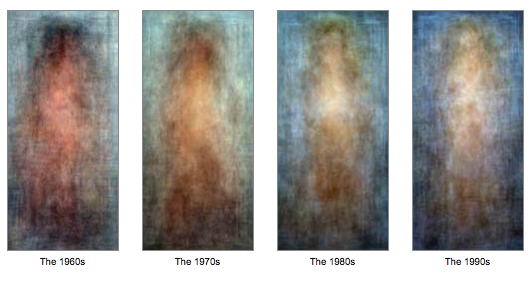
    ••• Jason Salavon


    Every Playboy Centerfold, The Decades (normalized)  2002

    Digital C-prints
    60" x 29.5" ea. Ed. 5 + 2 APs

    Picture 3

    From a broader series begun in 1997, the photographs in this suite are the result of mean averaging
    every Playboy centerfold foldout for the four decades beginning
    Jan. 1960 through Dec. 1999. This tracks, en masse, the evolution
    of this form of portraiture. 

    [link]

    ••• John Cage – Organ²/ASLSP (As SLow aS Possible)

    Originally composed in 1987 for the organ, Cage's piece holds the title of longest-lasting musical performance to date.  Cage opted to leave out any specific details as to how slow exactly the piece should be played, other than "as slow as possible"

    The current organ performance of the piece at St. Burchardi church in Halberstadt, Germany. It began on September 5, 2001 and is scheduled to last 639 years; finally ending in the year 2640.

    The chords change about every year or so, and here is a New York Times article about one such chord change in 2006. "The performance is in keeping with Cage's efforts to explore the
    boundaries of performance and how music exists in time and space."

     
  • Unknown's avatar

    Yury Gitman 8:54 pm on February 18, 2009 Permalink | Reply  

    time-based library findings 

    •••  Gary Hill – Circular Breathing (1994)

    this video installation uses several projected panels.  audience is intended to watch the panels from left to right follows the structure of reading and writing. the images consist of people doing actions, such as reading a book, or a hand writing on a page. the relationship of the sound and the image, as well as the timing of the images is what tears the audience from normal experience of time passing. sequences of images are triggered by specific actions of other images; each action is symbolic of the splitting of the whole, or the ending of one phase and the beginning of another.  in each sequence, as the images begin to flicker rapidly, accompanied by a loud, agitated sound, and an obscured narrative appears to build.  the flickering and altered speed, like the slow breathing of tai chi, shift the viewer's focus form the habitual linearity that searches for a literal meaning to deep perceptual questioning.

    from: Seeing Time: Ross, David A., Robert Riley, Marita Sturken, Chrissie Iles, Thea Westreich.  Selections from the Pamela and Richard Kramlich Collection of Media Art. SFMOMA, 1999. pp. 120-123.

    •••  David Goldenberg – Microwave and Freezerstilts (1992)

    surveillance cameras which are ubiquitous in contemporary culter appeared in art galleries in the 1970s in anticipation of what was to come.  Goldenberg had his video cameras monitor audiences who could see their images in mirrored chambers they were unable to enter.  past, present and future were collapsed in a maelstrom of self projections.  present tense is no more readily felt than in seeing oneself all of a suddenon a monitor in the middle of an exhibition.  time lapse can also provide immediate experience of time just passed as when a viewer's previously recorded image plays on one monitor as their present image is shown on another.

    from:  Rush, Michael. New Media in Late 20th-Century Art. Thames and Hudson, 1999. pp.124.

     
c
Compose new post
j
Next post/Next comment
k
Previous post/Previous comment
r
Reply
e
Edit
o
Show/Hide comments
t
Go to top
l
Go to login
h
Show/Hide help
shift + esc
Cancel