Updates from April, 2011 Toggle Comment Threads | Keyboard Shortcuts

  • Unknown's avatar

    Behnaz Babazadeh 5:42 pm on April 7, 2011 Permalink | Reply  

    Plausibility Tests 

    Today I ran a series of tests to see where the technology might be limited in and/or if it is completely plausible.

    http://vimeo.com/22087821

    Here I experimented with the possibility of incorporating illustration board into the novelty cards to give shape and structure. The alloy was able to move the pieces, however the shape was a little distorted. I believe I can achieve the right type of interaction with the use of several alloys on each corner.


    http://vimeo.com/22087547

    Part of a series of experimentation of how shape memory alloys react with in the oven and at what temperature. This alloy was placed inside of a conventional oven at 150 degrees. The alloy went from a stretched state at 3 inches to its compressed memory state at 1 inch, all in just one minute in this oven.


    Conclusion | I can definitely use shape memory alloys as the technology to change flat shapes into 3 dimensional shapes with in the convenience of a standard home oven.

     
  • Unknown's avatar

    Behnaz Babazadeh 5:05 pm on April 7, 2011 Permalink | Reply  

    Interactive Novelty Cards 

    Currently there are absolutely no other paper/novelty products that utilize SMAs (Shape Memory Alloys) technology.

    1) The current trend in smart novelty cards seem to be in soft circuit space of paper craft and conductive inks. Novalia is a company that has been started by Cambridge professor Dr Kate Stone. They create flat circuits on paper to get interactive simple circuit greeting cards. Most of which are simple, push button/ light led. Click Here for the Article.

    2) Here is a video of a neat greeting card hallmark is doing with augmented reality. Hallmark wants to go Hi-Tech!

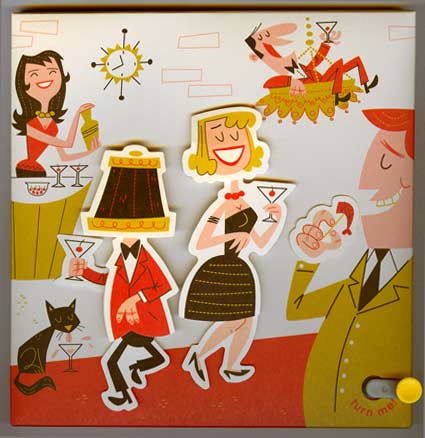
    3) The standard tech cards that everyone has seen such as pop up cards and musical cards.

     
  • Unknown's avatar

    Oylum 4:36 pm on April 7, 2011 Permalink | Reply  

    Prior Art 

    I found some prior work related to over distance emotional impact or haptic outputs.
    My keywords are: Haptic feedback, telepresence toys, virtual/physical existence.
    Most of them have more science oriented approach, you can tell it even from their interfaces. Here are some examples:

    Augmented reality puts the squeeze into virtual hugs:

    Virtual hugs
    It uses Second Life to communicate. It matches your words in Second Life with emotions and convey that emotion to your partner. In the video, there are 2 characters in Second Life, hugging each other, talking, getting excited atc. The look and feel is horrible! So technical, so engineer style. Would you wanna walk around wearing this? And the guy, he’s like Clark Kent – The Engineer!

    (More …)

     
    • Willie's avatar

      Willie 10:12 pm on September 12, 2011 Permalink | Reply

      What an awesome way to explain this-now I know everiytnhg!

  • Unknown's avatar

    Behnaz Babazadeh 4:09 pm on April 7, 2011 Permalink | Reply  

    Materials Exploration | Symposium 

    Parsons Fashionable Technology Event Series continued on the 31st with a series of lectures and demonstrations from the people in the industry who are doing interesting things in their field relating to fashionable / wearable technology.

    This is a video of my favorite talk at the symposium. I think was was really great to see the variety of different materials out there available that I had never heard about before. You can thank me later for shooting this video 🙂

    http://vimeo.com/22063204

    Below are some of the interesting things Bare Conductive is up to with their patent non-toxic conductive ink.


    Conductive Ink Track Pad

    Conductive Ink Switchs / Potentiometor for outputs of light / sound.

    Conductive Ink Flex Sensor

    According to Matt Johnson from Bare Conductive, this ink will not be available for purchase for quite some time. Huge bummer for some soft circuit friends of mine who would have loved to use this ink for their mini-thesis.

     
  • Unknown's avatar

    andywallace 5:55 am on April 7, 2011 Permalink | Reply  

    Gyroscope Vs Accelerometer 

    Tilt Sensors are still on their way, but my Sparkfun order came in today, along with some foam balls I orderred form Amazon! I didn’t get home until late, so I have not had too much of a chance to play with my new toys, but I did experiment a bit with the gyroscope and accelerometer as a way of getting the velocity of the ball (or at least something close enough to the velocity to fool any user).

    I set up simple openFrameworks app to monitor each sensor and see how it reacted to different movements. I really wanted to get each of them in a ball using xBee, but something is going wrong with one of my xBees. I’m going to look into it tomorrow. Instead, I put the gyroscope in the ball and used long wires to attach it to the Arduino. Unfortunately, this limited the movement a lot more than I was expecting it to, and the ball really is not free rolling at all.

    (More …)

     
  • Unknown's avatar

    Behnaz Babazadeh 4:57 am on April 7, 2011 Permalink | Reply  

    Materials Exploration | Workshop 

    Last week I attended the Materials exploration workshop held by the fashionable technology team of Parsons. Here is a link to the fashion tech blog. Below are some interesting materials and facts I discovered over the course of the event.

    Workshop materials included; Woven Optic Fabric, Photo Luminescent Fabric, Photovoltaic Fabric, Heating Fabric, Liquid Crystal Fabric and Anti-Magnetic Fabric.

    The workshop was sort of set up as a game, where each group of students were to pick up a set of cards with constraints listed. My team got

    WHO – With friend
    WHEN – A slow time
    WHERE – In a big city
    WHAT – Photovoltaic

    We came up with several different projects and ideas for using the technology with these set of constraints.

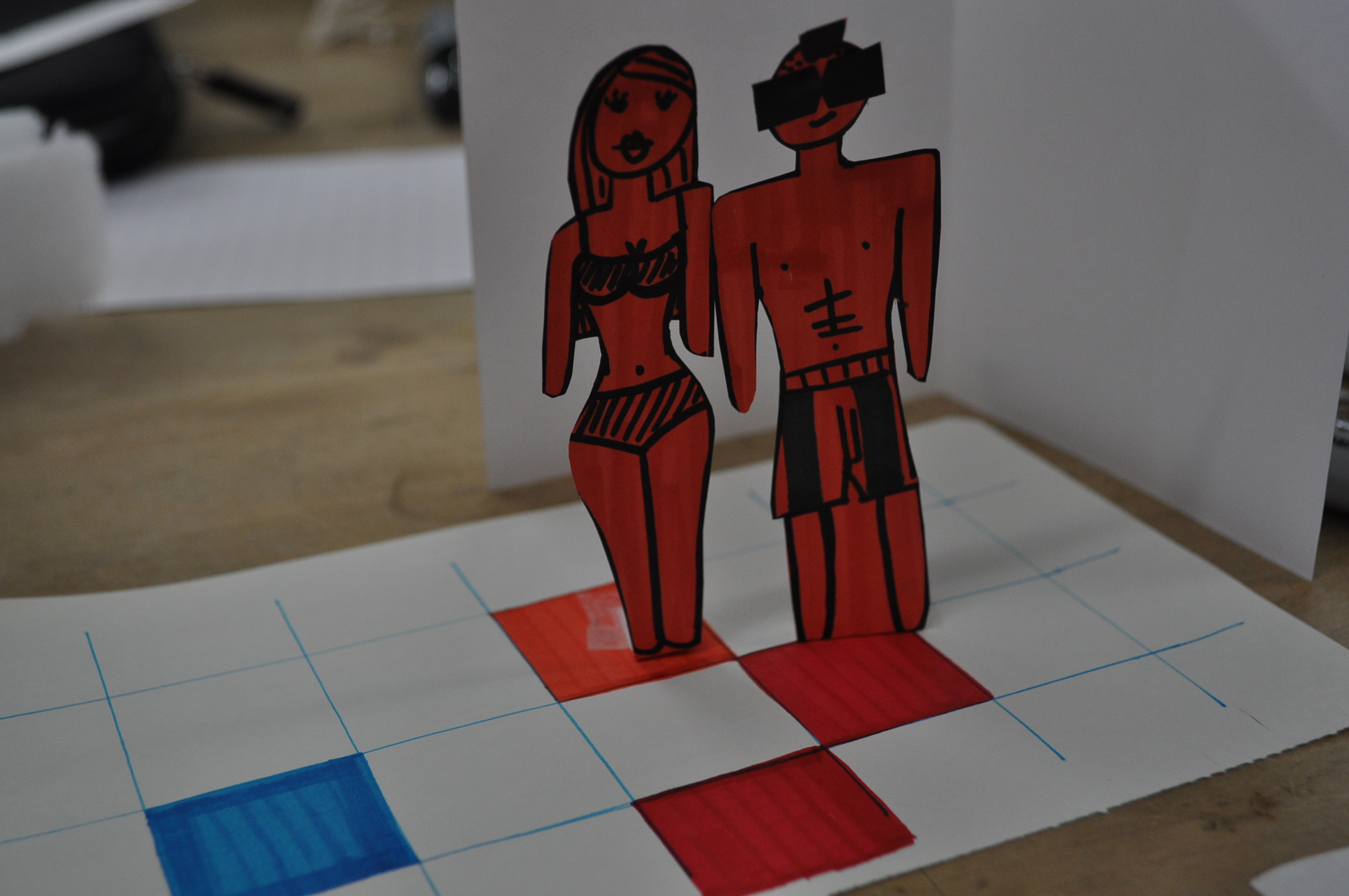
    The idea we followed through with was Dance Dance Beach Blanket. An interactive blanket that can use the solar energy power received from sitting out in the sun all day, getting your tan on like JWOW and The Situation (See image below) and when the sun goes down, the party continues with this networked, dance dance revolution and twister inspired interactive light up game.

    In the end, I think it was a fun way to structure a workshop but it was unfortunate that we got a material that was not available for us to cut up and prototype.

     
  • Unknown's avatar

    andywallace 8:48 pm on April 6, 2011 Permalink | Reply  

    Hunting through patents 

    As Yury suggested last week, I dug around google.com/patents looking for things that relate to my project. I think I still need to get the hang of how to effectively search, but I did find some useful stuff.

    There are a lot of toy balls (especially for pets) that produce sound by pushing air or liquid through a tight space: Effectively a squeaker. Not exactly what I want to do for my project, but it is worth remembering that people have been making balls that make sound for a while.

    A slightly more useful one in this category was this patent that I immediately recognized form my childhood. This was used by Nerf to make foam footballs with a whistle on them. It didn’t change the use of the ball at all, but having a sound made the ball more fun, especially since the sound would be more intense with a faster throw. Still not making music, but definitely exploring play and sound generation.

    This interesting device is a ball that acts like a rainstick. It has an inner ball that creates a space between that inner sphere and the outer sphere that is filled with little particles that move over bumps on the inner balls surface as the ball move around. This was made for sue with young children and claims that the sound has a generally soothing effect.

    Getting closer to my project, this is a ball with a sensor to detect impact on it that makes a sound using a built in speaker when it is hit. This project was designed for use in sports and is not terribly clear about what kind of sound is made.

    This ball seems interesting, but I don’t know if it is really doing as much as the patent description would have you guess at first. Essentially, it’s a wooden flute-like object inside a ball that can be squeezed to send air through the flute. It was designed as a music/sound maker, though, which is definitely closer to what I’m doing.

    I’ll keep hunting, but this was largely good just for reminding me about the other more utilitarian reasons for having balls make sound (such as sports or pets), and the old school methods of doing so (such as mounting a bell inside).

     
  • Unknown's avatar

    Bree 4:48 pm on April 5, 2011 Permalink | Reply
    Tags: mini-thesis,   

    Didget 

    This product does a lot of what I was thinking of doing, however, I can’t seem to get the demo game to play. I’ve ordered one for my DS from eBay for $8, which is $60-$80 at medical supplies shops (most meters are fairly cheap $10-$30 because companies make tons of money on selling the testing strips).

    Anyway, here is what I have seen of the Didget product so far…

    (More …)

     
  • Unknown's avatar

    Yury Gitman 2:16 pm on April 5, 2011 Permalink | Reply  

    Tilt Switch in a Can, great for a few of you. 

    Lee, if you want to see if lid is “open or closed”, these are great.
    Scott, if you want to see a finger tilted or not, these are great.  You’ll like their “rolling ball” build.
    Andy, these can give you many axis’s, as we discussed in meeting. With 6, and the right snappy code, they can give you a lot of gesture awareness.

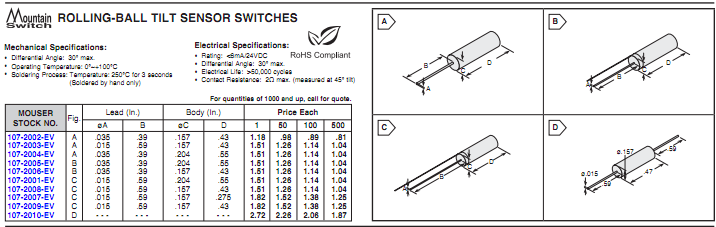
    These are the “Rolling-Ball” Tilt Switches (not sensors). They are little canisters that have been around since the 30’s (in slightly larger sizes).  They map to physical motion very well. They are binary, on or off, and make for easy coding and a responsive interface.  If you use 3 of them you get 3 axis’s of motion.  If you use 6, likewise you get more axis’s, and/or very hi-res readings.  They are ~$1-2 in cost.  I know you are going to want them, even if you don’t use them in your first implementation prototypes.  So it might be good get a small order for them in process now.

    Mouser-page1989-Rolling-Ball-Tilt-Switch

     
    • andywallace's avatar

      andywallace 8:18 pm on April 6, 2011 Permalink | Reply

      I Just bought 10. They’re super cheap, but the shipping is kind of pricey, so buying more is probably a good idea.

      Sorry I didn’t see this earlier; I would have suggested a group order.

    • scottpeterman's avatar

      scottpeterman 8:43 pm on April 6, 2011 Permalink | Reply

      This is great Leif! gonna grab some as well, enthusiastic that this could be totally the right solution… THANKS!

  • Unknown's avatar

    thisisvictorkim 1:58 am on April 5, 2011 Permalink | Reply  

    Aesthetics of Interaction 

    Thought this paper that Yury referenced during my crit could be useful for everyone:

    Click to access PB-572.pdf

    The paper itself is on page 31.

     
  • Unknown's avatar

    Bree 11:13 pm on April 4, 2011 Permalink | Reply  

    feedback for glucogame 

    Apparently, Bayer and Nintendo already did this *sigh*

     
    • Yury Gitman's avatar

      makingtoys 2:18 pm on April 5, 2011 Permalink | Reply

      You should still get screen by screen “screen-shots” if their interface if available. Look hard. Also, please document the screen-shots of current medical devices that do this. Look at the interface state-of-the-art for this concept.

  • Unknown's avatar

    lpercifield 10:15 pm on April 4, 2011 Permalink | Reply
    Tags:   

    Oh crap… 

    The idea behind this project is to allow NYC residents to help reduce the amount of pollution in the harbor. Some 27 billion gallons of raw sewage is dumped into the harbor every year. This comes from Combined Sewer Overflows (CSOs) that open when the sewer system is overloaded. The idea is to enable residents to understand when the overflows happen and reduce their wastewater production before and during an overflow event.

    Photos of the CSO target for this prototype:

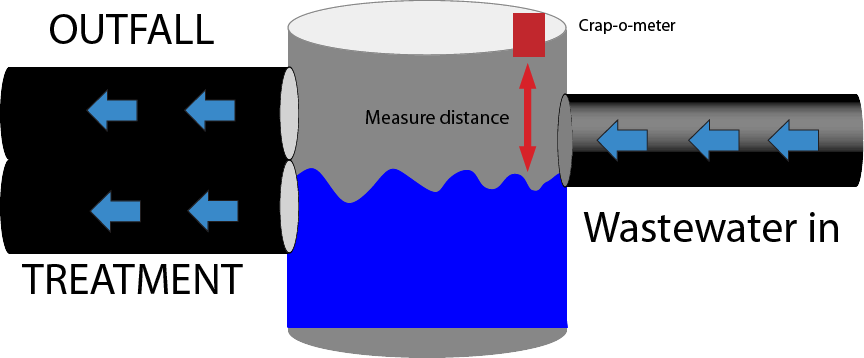
    The simple sensor that I am prototyping utilizes an arduino, a proximity sensor, and a cell phone. The idea is that the proximity sensor will measure the water level at the CSO and transmit this data, via the cell phone, to a database. This information will then be shared to the users of the system.

    The data collected from this network of sensors will be availble to users on a website, alerts will be sent by SMS and a prototype of an in home visualization of the CSO status will be set up. Something similar to the Ambient Devices weather beacon.

    A simple sketch for this device would include using a xbee network and arduino:

     
    • lpercifield's avatar

      lpercifield 12:13 am on April 5, 2011 Permalink | Reply

      Steve Duncan is going to help me out with this…

      The cell phone will be mounted in a pelican case to make it look like an official sensor. The parts will be very cheap so it won’t be a total loss. I hope to access the gps capabilities of the cell phone to potentially track the device if its lost.

      Data from cell phone:
      BATT: 66 RSSI: 23 DST: 68

  • Unknown's avatar

    Bree 10:03 pm on April 4, 2011 Permalink | Reply  

    GlucoGame 

     
  • Unknown's avatar

    Lee 10:01 pm on April 4, 2011 Permalink | Reply  

    OmNom is a go! 

    all Parts are ordered! So this weekend I started designing personalities, sounds and an enclosure.

     
  • Unknown's avatar

    Chris Piuggi 9:29 pm on April 4, 2011 Permalink | Reply  

    Back to Aquaponics 

    After spending the weekend researching and collecting supplies I have diagramed my proposed system for aquaponics.

    I will be tracking ph, light, temp, and humidity of the plants. I decided to leverage some of the findings from the window Farms project, while integrating a natural source of nutrients. My hope is to track and visualize data on the web in addition to attempting to create a system which will regulate itself.

    Here is an image of the proposed system, and the location of that system in my house:


    • Chris Piuggi's avatar

      Chris Piuggi 10:23 pm on April 4, 2011 Permalink | Reply

      Feedback….

      How will the light sensor and temp sensor work for the system?

      • Leif knows of a moisture sensor which could counteract the need for these two sensors.

      What will be done about the oxygen levels for fish at night?

      Is this a system or a product?

      Create a document or timeline for how and when each part of this project will be completed in a way to realize the tasks that need to be completed as well as understanding the ‘unknown’?

      What is the scale of the object? Is is something I can carry around?

    • Oylum's avatar

      Oylum 4:00 pm on April 5, 2011 Permalink | Reply

      This is not the same as your system but can be an example of prior art:

      http://sternlab.org/2010/04/hydroponic-herb-garden/

  • Unknown's avatar

    catherine 9:13 pm on April 4, 2011 Permalink | Reply  

    Interactive Knit Environment 

    For my mini thesis, I am going to explore installation design, knitting and music. I want my user to enter the environment, sit down and begin knitting. Once the user begins to knit, small sounds are heard from the fibers as the user knits more the sound become more apparent and melodic. At the end, the user would be immersed in sound. The user would leave with a finished hand knit product and a mp3 of the sound they created. Each hand knit product would generate a different sound based on the weight of the product.

    Knit Stretch Sensor
    The values of the sensor range from roughly 4000 Ohm when relaxed, to 200 Ohm when fully stretched. Maybe I can incorporate conductive thread into the yarn and music will be made based on stretch values. The instructable: http://www.instructables.com/id/Circular-Knit-Stretch-Sensor/

    I need to examine how people knit so I can pay attention the elements of knitting I can attach sound too.

    THE LOOK & FEEL OF THE LAMP.

    IMPLEMENTATION OF LAMP.

    Untitled from kate strassman on Vimeo.

     
    • catherine's avatar

      catherine 10:39 pm on April 4, 2011 Permalink | Reply

      have you thought about using an accelerometer or gesture recognition to track the patterns of knitting or what your movements are?
      you could amplify the sound of the aluminum needles as you knit. Amplify the sound of thread. Caitlin and Liza? did a project where they amplified the sound of a bridge.
      Play with conductive thread and the resistance of the needles as input.
      Play with thread and look at the output/input of sound, light and time.
      What is the outcome besides the scarf? Augment.
      Knitting is a 3D form. Two wires=3D form map to knitted creation.
      You can embellishing an activity not making a musical instrument.
      Search YouTube for the 3 most popular knitting techniques (3 most common) isolate those 3 and use them to predict motion.

      Pull out the sounds you want, sequence of sound or a library and plan the sounds you want to create while knitting.

      You are making an interactive experience, not environment.

  • Unknown's avatar

    thisisvictorkim 8:56 pm on April 4, 2011 Permalink | Reply  

    Autobots, ROLE Out 

    Get it?

    anyways

    So going off my Sex Drugs & Rock and Roll object I decided to focus on one object.

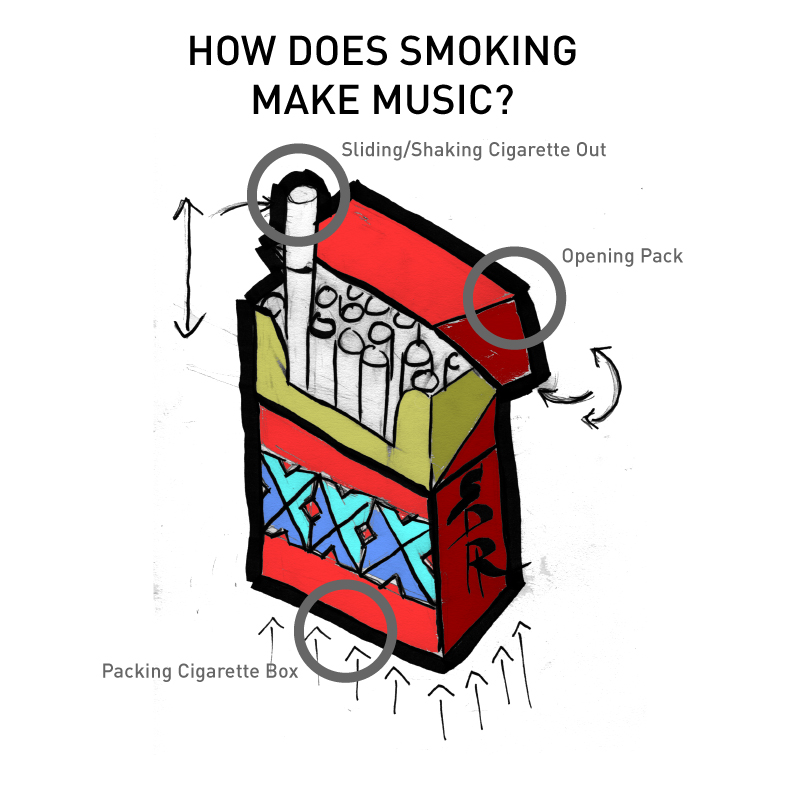
    The different interactive characteristics of a cigarette box can be mapped to different sounds.  A pack of smokes naturally makes rhythmic sounds.  What sounds can be mapped so the interactions aren’t changed from a habitual smoker? A slide whistle for sliding a cigarette out? A muted trumpet for opening the pack? Drums for packing the box?


    My big question still remains in what medium to present this.  perhaps a short film to fake this act.  I dunno if I can actually make this.

     
    • thisisvictorkim's avatar

      Victor Kim 11:41 pm on April 4, 2011 Permalink | Reply

      LOOK UP Lisa Li – Paper Piano project
      READ Designer Management Article on Noam Toran
      READ Aesthetics of Interaction
      THINK ABOUT Character first
      THINK ABOUT WHY these objects
      THINK ABOUT Subverting the cultural meaning
      THINK ABOUT Sound at the end?

  • Unknown's avatar

    Oylum 8:54 pm on April 4, 2011 Permalink | Reply  

    New Project Idea 

    I changed my project recently, I’m not doing the cigarette box. Instead, I decided to design an interface for a child to communicate with somebody he loves over distance. It will be in the form of a plush toy.

    I have an advanced level ideation of the final design, however, I might not get all the functions working at the end of this time period. I don’t see it as a problem for now, because the minimum will be achieving the goals of the project, hopefully.

    Here are the prototypes:

    Look&Feel


    (More …)

     
    • Oylum's avatar

      Oylum 11:19 pm on April 4, 2011 Permalink | Reply

      Feedback from class:

      1. Research more about precedents and find prior art. Beck Stern-Squid is one of them for example.

      2. For the technical part, you might consider using Arduino with ethernet shield and xBee wireless network. Digiconnect is another option but it is harder to get it working.

      3. Start working on look and feel. work on glowing head, how you want the translucent be like, how the LEDs will look like on the plushy octopus.

      4. Think about asynchronous communication. Time is an important factor to create emotional effects.

      5. Research more about pulse and vibration sensors. Prototype the feeling you want to get using these sensor.

c
Compose new post
j
Next post/Next comment
k
Previous post/Previous comment
r
Reply
e
Edit
o
Show/Hide comments
t
Go to top
l
Go to login
h
Show/Hide help
shift + esc
Cancel